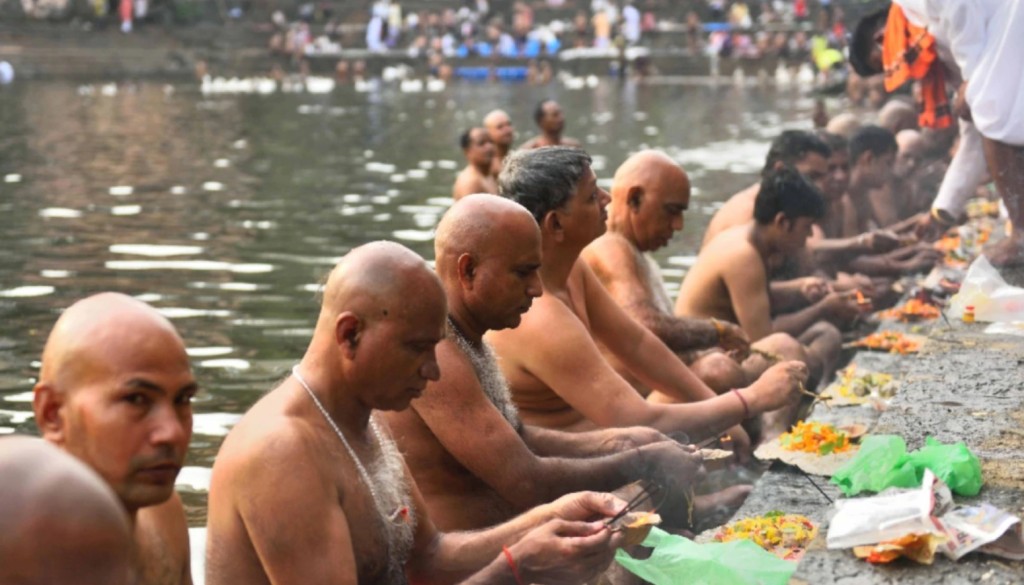
Patna: The Bihar government’s new initiative to digitise the ancient ritual of Pind Daan has sparked widespread criticism from religious groups even before its launch. The scheme, which allows devotees to pay Rs 23,000 online for priests in Gaya to perform the rites on their behalf, has been condemned by the local Panda community and the Vishwa Hindu Parishad (VHP) as a violation of sacred tradition.

The Online Pind Daan Yojana, introduced by the Bihar Tourism Department, is scheduled to coincide with the Pitru Paksha fair starting September 6. According to the government, devotees who cannot physically visit Gaya due to health, financial, or time constraints can book the ritual online. The priests will conduct the ceremony on their behalf, recording the proceedings and providing a pen drive to the devotee. Officials claim the scheme is intended to promote religious tourism while offering convenience to those unable to travel.
However, the proposal has met strong opposition. Mani Lal Barik, president of the VHP in Gaya, argued that the ritual must be performed by a male family member, usually a son, at sacred locations including the Vishnupada Temple, Falgu riverbank, or Akshayvat. “Performing it by someone else is a violation of religious decorum,” he said. Mahesh Lal Gupta, a senior Panda priest, added that the emotional connection of personally invoking one’s ancestors is essential, and that outsourcing the ritual “will hurt the dignity and sanctity of Sanatan Dharma.” Both called on the government to withdraw the scheme and consult religious authorities first.

Government officials defended the initiative as a practical solution for devotees unable to travel. Dr Prem Kumar, Bihar’s Cooperative Minister and Gaya MLA, said the government respects religious sentiments and plans to review the scheme after discussions with all stakeholders. “Conducting the rituals digitally will be a relief for those whose devotion is genuine but whose circumstances prevent them from visiting Gaya,” a department spokesperson said.
Religious scholars stress that Pind Daan is a deeply personal act, requiring the emotional and spiritual presence of family members. Texts such as the Garuda Purana, Vishnu Dharmasutra, and Manusmriti outline that the rites must be performed by close kin to ensure the peace of ancestors’ souls. While some leaders acknowledge that delegated ceremonies could be considered a form of atonement, they maintain that such practices do not constitute complete Pind Daan.
At the local level, the Panda community warns that the digital scheme could threaten both tradition and livelihood. During Pitru Paksha, Gaya sees lakhs of devotees, boosting not only religious activity but also the city’s economy. A shift to online rituals, they argue, could reduce footfall and disrupt local commerce.