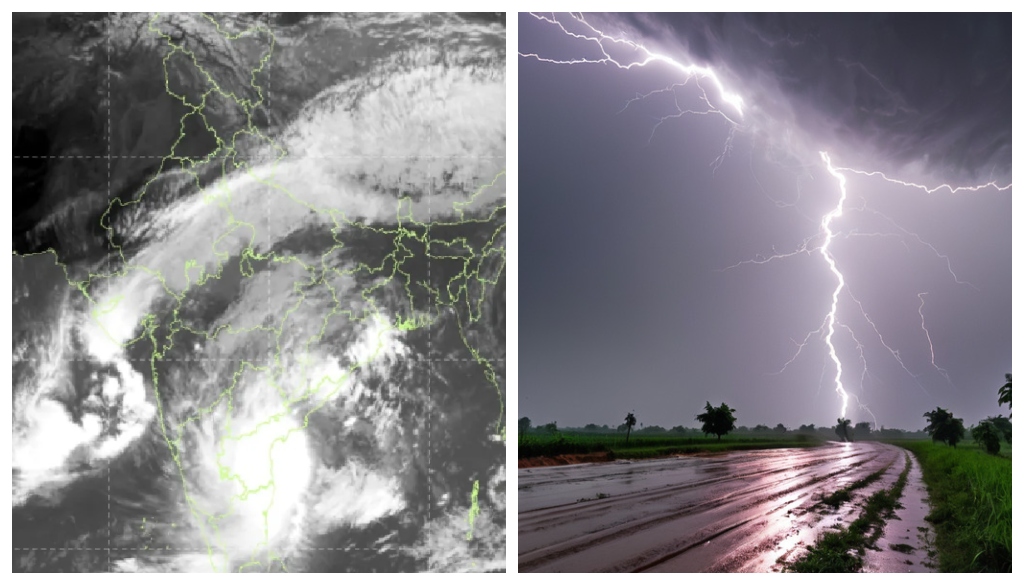
Patna: Bihar is bracing for a spell of severe weather as Cyclone Montha, which developed over the Bay of Bengal, moves northward, bringing with it heavy rain, strong winds, and thunderstorms.

The India Meteorological Department (IMD) has placed several districts under red and orange alerts, warning of potentially disruptive conditions between October 30 and 31.
The cyclone, which struck the Machilipatnam and Kakinada coasts of Andhra Pradesh on Tuesday morning with winds of 100–110 km/h, is now weakening as it travels inland through Odisha, Chhattisgarh, and Jharkhand, before reaching Bihar as a low-pressure system. Despite its reduced intensity, the storm is expected to bring widespread rainfall and thunderstorms across the state.

“The impact of Montha will be felt across Bihar for at least four days,” an IMD official said. “While the cyclone is weakening, its moisture and wind systems will trigger heavy rainfall and a significant drop in temperature.”
Red Alert for Seven Districts, Heavy Rain in Patna
According to the IMD’s forecast, southern districts including Jamui, Banka, Munger, and Bhagalpur are likely to experience heavy to very heavy rainfall on October 30, prompting a red alert.
On October 31, the storm’s impact will extend northward, with Patna, Gaya, Katihar, and both East and West Champaran expected to receive heavy rainfall and strong winds of 30–40 km/h.
The weather department has urged people to avoid open areas, trees, and electric poles during the storm and to stay indoors during lightning. Officials also advised limiting the use of mobile phones and electrical appliances during thunderstorms.
प्रेस विज्ञप्ति: चक्रवाती तूफान “मोंथा” के प्रभाव से बिहार में संभावित वर्षा गतिविधियाँ (30–31 अक्टूबर 2025) pic.twitter.com/gFC2yuHIiu
— Mausam Bihar- IMD Patna (@imd_patna) October 27, 2025
Relief Measures and Administrative Preparedness
District administrations have been instructed to remain on high alert.
Flood control rooms have been activated, and disaster response teams have been deployed in low-lying and flood-prone areas.
Officials said the administration is prepared to provide immediate relief and rescue operations if needed.
“We have placed all disaster management teams on standby and activated district-level control rooms,” said a senior state disaster management official. “People are urged to remain cautious and follow safety advisories.”
How Cyclone Montha Formed
The name ‘Montha’, meaning fragrant flower, was suggested by Thailand.
The cyclone originated as a low-pressure system in the southeast Bay of Bengal and intensified into a severe storm by Monday night. After making landfall in Andhra Pradesh, it caused power disruptions, uprooted trees, and landslides in several coastal regions before beginning to weaken inland.
Despite losing intensity, the storm continues to carry moisture-laden winds, which are now driving widespread rain across eastern India, including West Bengal and Jharkhand.
Temperatures to Drop After the Storm
The IMD expects the weather in Bihar to cool significantly after October 31, as Montha’s remnants move northeastward.
Daytime temperatures are likely to fall by three to four degrees, marking the first notable temperature drop since the end of monsoon.
The state, which has already recorded 128 mm of rainfall this month, may see its wettest end to October in recent years.
With cool winds expected to arrive by early November, residents could experience the season’s first mild chill in the mornings and evenings.
“This storm will not only bring rainfall but also a change in the season’s rhythm,” said a Patna-based meteorologist. “After Montha, winter will begin to set in.”