Patna: Bihar’s Cooperative Department has stepped up its efforts to transform the state into a hub for vegetable production under its ambitious motto, “Bihari Vegetables in Every Thali”. In a major push for farmer empowerment and better market access, the department organised a one-day training-cum-workshop at Patna’s Urja Auditorium on Monday, drawing participation from officials, experts, and presidents of Primary Vegetable Producer Committee Ltd. (PVCS) from all districts.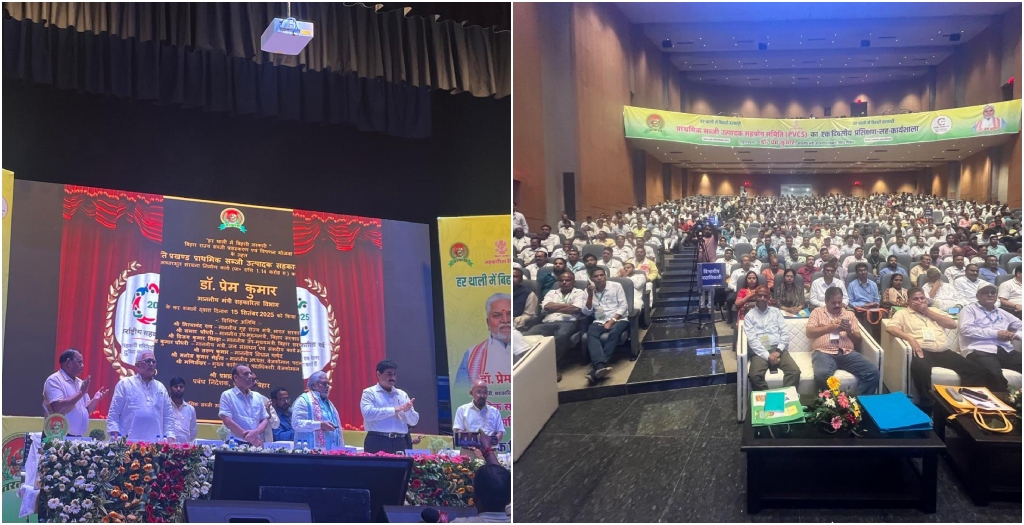

According to officials, PVCS registration has been completed in 529 blocks across Bihar. This network of committees plays a key role in bringing farmers together, offering them access to quality seeds, modern farming techniques and a platform to directly connect with buyers. Cooperative officials appealed to PVCS chairpersons to launch a state-wide membership campaign so that more small and marginal farmers can benefit from the initiative. By expanding membership, the government hopes to ensure steady vegetable supply, reduce dependence on middlemen and guarantee fairer prices for farmers.
The event was inaugurated by Dr Prem Kumar, Minister of the Cooperative Department, who also laid the foundation stone virtually for a series of infrastructure projects designed to improve the vegetable supply chain. Warehouses for onion storage will be built in Matihani and Teghra in Begusarai, Ekangarasarai in Nalanda, and Tajpur in Samastipur. Additionally, infrastructure development for PVCS will take place in Barh (Patna), Hilsa (Nalanda), Vidyapati (Samastipur), Tajpur (Samastipur) and Bihiyan (Bhojpur). These projects aim to help farmers avoid post-harvest losses, which have historically been a major challenge due to lack of cold storage and warehousing facilities in Bihar.

Speaking at the workshop, Dr Kumar highlighted the importance of strengthening PVCS for the state’s agricultural future. “Our goal is not just to boost production but also to make sure that farmers get the best value for their hard work,” he said. “By providing them with advanced technology, high-quality seeds and direct market access, we are cutting out middlemen and increasing their profits.” Officials added that these steps will bring Bihar closer to its vision of making local vegetables available to every household, ensuring both nutritional security and rural economic growth.
The workshop also featured technical sessions where experts shared best practices on vegetable cultivation, pest management and post-harvest handling. Farmers were trained in ways to improve productivity while reducing input costs. Participants expressed optimism that with improved storage and marketing support, they will be able to supply vegetables not only to local markets but also to other states.
The Cooperative Department’s focus on PVCS and storage infrastructure is expected to have a lasting impact on Bihar’s agricultural economy. By creating an organised supply chain, the state aims to reduce wastage, stabilise prices and make fresh produce more affordable for consumers. If successful, the initiative could serve as a model for other states looking to empower small farmers and strengthen local food systems.