Patna: A ten-day intensive training programme aimed at enhancing the technical expertise of Bihar’s Rural Works Department (RWD) engineers commenced on Thursday at the Indian Institute of Technology (IIT) Patna.

The programme, titled Infra Impact: Integrated Training on Bridge and Pavement Design, Inspection, Monitoring, Performance Assessment, and Capacity Building, is jointly organised by IIT Patna’s Department of Civil and Environmental Engineering and the RWD. In its first phase, running from November 20 to 29, 60 assistant engineers will participate, while the full initiative is expected to train around 500 engineers across multiple phases.
The training seeks to strengthen professional skills in areas including bridge hydrology, foundation engineering, structural modelling, condition assessment, pavement design, and modern maintenance and monitoring technologies.


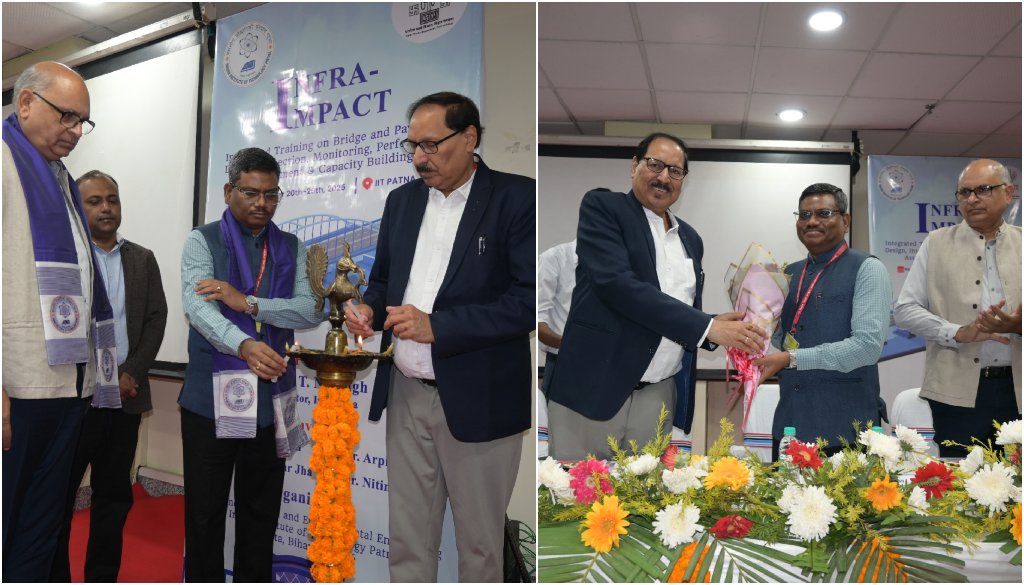
The programme was inaugurated with a lamp-lighting ceremony attended by M. Saravanan, IAS, Secretary of the RWD; Prof. T. N. Singh, Director of IIT Patna; Sanjay Kumar, IAS, Joint Secretary, RWD; and senior faculty members of the institute. Dr. Vaibhav Singhal, one of the workshop conveners, outlined the training schedule, and Dr. Amit Kumar Verma, Head of Department, delivered remarks.
Speaking at the event, Sanjay Kumar emphasised the importance of capacity-building initiatives in improving the durability, quality, and safety of rural infrastructure in Bihar. Prof. T. N. Singh highlighted the value of a scientific approach to bridge engineering and encouraged participants to adopt a global perspective in design, evaluation, and public service.
Secretary M. Saravanan noted that technical and managerial capability is crucial to delivering resilient and sustainable rural infrastructure, adding: “Concentration drives excellence, while imagination enables innovation.”
Over the ten days, participants will engage in lectures, laboratory demonstrations, and hands-on sessions covering hydrology and hydraulics, foundation and structural design, quality management, condition assessment, and retrofitting, equipping engineers with both conceptual knowledge and practical skills.