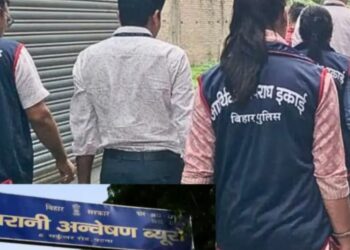
Patna: In a significant development in the murder case of Buxar gangster Chandan Mishra inside Paras Hospital in Patna, police have reportedly detained a person identified as Tausif Badshah. CCTV footage of Chandan Mishra’s murder clearly shows Tausif Badshah in the foreground, armed.

All five shooters captured in the CCTV footage related to the incident have also been identified. Tausif Badshah, believed to be the main accused in Mishra’s murder, reportedly comes from a family where his mother is a teacher and his father runs a hardware shop. Police are also investigating their call records as part of the probe.
The Alleged ‘Badshah’ of Land and Contract Killings

According to information obtained, Tausif Badshah is an alumnus of St. Karen’s School in Patna and is involved in the land business in the Phulwarisharif area, where he is colloquially known as ‘Badshah’. It is suspected that beyond land brokering, Tausif also allegedly took on contract killings. This has led to fears that Chandan Mishra’s murder was also a contract killing.
In the ongoing search for the absconding main accused, a joint team of Patna Police and STF today raided his hideouts in Gulistan and Minhaj Nagar Mohalla of Phulwarisharif.
Sheru Gang Suspected in Supremacy Battle
All criminals involved in the murder have been identified, and police are actively raiding their hideouts. Sources indicate that the Sheru Gang is suspected to be behind this audacious incident. The fact that the criminals fled towards Buxar after committing the crime has further intensified suspicions of a Buxar-based gang’s involvement.
Police sources reveal a history of rivalry between Chandan Mishra and Sheru. They were reportedly friends initially, with Chandan even operating his gang under the “Sheru Gang” name. However, the two later parted ways, and a dispute between them is also said to have occurred in Bhagalpur jail. Police sources suggest that Chandan Mishra’s murder was a result of a fight for supremacy between rival factions, a suspicion that arose immediately after the manner in which the killing was executed.