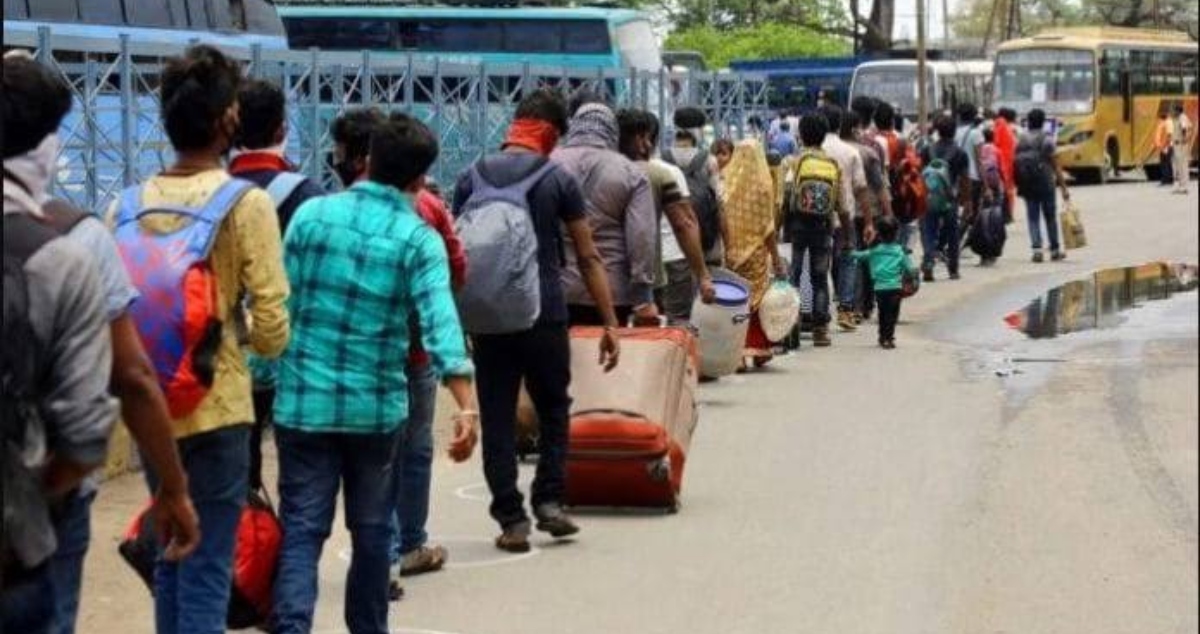
Patna: Migration has long remained one of the major and sensitive issues in Bihar. Every year, a large number of people leave the state in search of employment, better education, healthcare facilities and improved economic opportunities. Bihar’s workers can be found in large numbers across Delhi, Mumbai, Punjab, Haryana, Gujarat and several cities in southern India. Amid this situation, Bihar Chief Minister Samrat Chaudhary has made a major claim regarding migration from the state.

During a media interview, Chief Minister Samrat Chaudhary was asked about migration, one of Bihar’s biggest challenges, and whether the government has a plan to ensure that people do not have to move to other states for jobs and a better future after 2027.
Responding to the question, Samrat Chaudhary said that migration from Bihar would stop before 2030. He said the state’s infrastructure would become stronger in the coming years, institutions would improve and opportunities ranging from children’s education to employment for young people would increasingly be developed within Bihar itself.

Claim to transform Bihar by 2030
The Chief Minister’s statement has raised expectations about Bihar’s development. According to him, major changes will be visible in the state by 2030 across areas including infrastructure, education and employment. He indicated that efforts are being made to develop Bihar in a way that residents do not have to leave the state in search of a better future.
The government’s stated objective is to ensure that children receive quality education, young people get employment opportunities and families have access to better facilities without having to depend on other states. The focus is expected to remain on creating opportunities within Bihar itself.
Villages to be developed, new cities planned
Samrat Chaudhary did not limit his comments to employment alone. He also outlined a broader vision for the future of Bihar’s villages and cities. According to the Chief Minister, new cities will begin emerging in Bihar while villages will be developed in a more organised manner.
He said infrastructure in rural areas would be improved. Along with roads, transportation and other essential facilities, efforts would also be made to improve the overall environment of villages. This means the government’s focus is not only on developing major cities but also on making rural Bihar more modern and organised.
If these plans are implemented effectively on the ground, they could have a direct impact on employment-driven migration from Bihar. A large number of people leave villages and smaller towns because adequate employment opportunities and basic facilities are not always available locally.
Focus on opportunities from education to employment
The Chief Minister presented education and employment as two of the most important links in the effort to address migration. He said work would be undertaken to ensure that opportunities ranging from education to employment become available within Bihar.
The government’s effort in the coming years would therefore be to ensure that young people do not have to look towards other states for higher education, skill development and jobs. The expansion of better institutions and economic activities has been highlighted as part of this broader approach.
Will Bihar become economically stronger?
Samrat Chaudhary also said Bihar would begin becoming economically stronger. His view is that as infrastructure improves, new cities develop, institutions become better and employment opportunities increase, the state’s economy will also gain momentum.
Migration from Bihar is not merely an employment issue. Its impact can be seen across the state’s economy, families, villages and social structure. If sufficient employment and better facilities become available at the local level, the pressure to migrate could potentially be reduced significantly.
The big question: Can Bihar achieve the 2030 target?
The Chief Minister’s claim is ambitious—migration from Bihar will stop before 2030. The biggest question now is how quickly the government’s plans are implemented on the ground and whether they create enough opportunities for people across the state.
Millions of people in Bihar will be watching developments in employment, education, industries, infrastructure and rural development over the next few years. If adequate opportunities are created for education and employment, new cities are developed and basic facilities in villages are strengthened, Bihar’s development landscape could see a major transformation.
For now, the 2030 deadline has once again brought Bihar’s development and migration issue into the spotlight. The coming years will show whether the Chief Minister’s ambitious claim translates into visible changes on the ground and whether Bihar’s youth can eventually find enough opportunities at home instead of having to move to other states for employment.