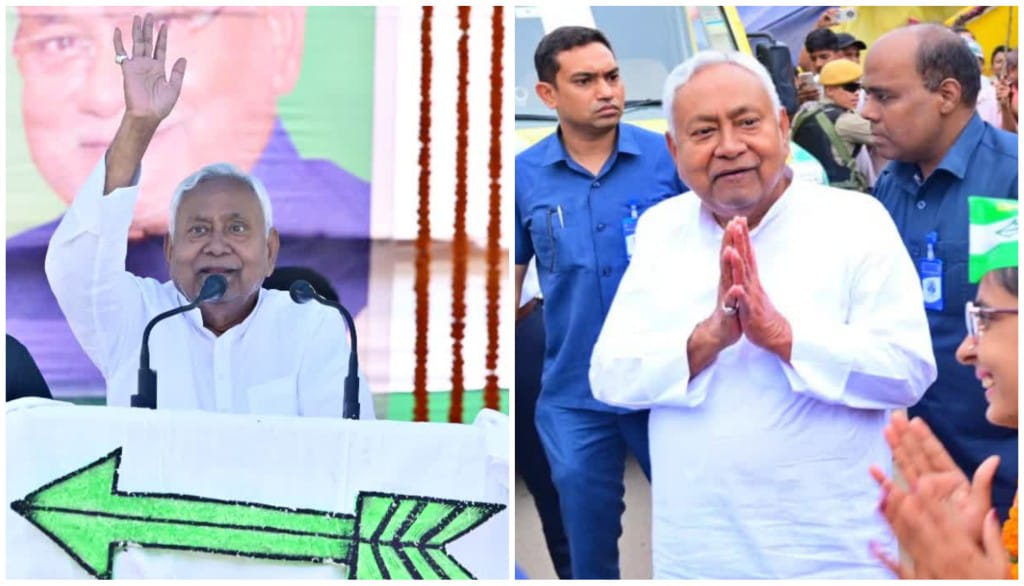
Patna: On the eve of the second phase of the Bihar Assembly elections, chief minister Nitish Kumar convened a strategy meeting at his official residence, drawing together some of the party’s most senior leaders for what insiders described as an “intense pre-poll review”.

Voting for 122 constituencies will take place on 11 November, with the campaign having formally ended on Sunday evening. Nitish Kumar, who held more than 40 rallies in the second phase alone — and over 80 across both phases — is said to be closely tracking feedback from party workers and district-level organisers.
Top JD(U) leadership in attendance
Those present at the meeting included Lalan Singh, Ram Nath Thakur, Vijay Kumar Choudhary, Ashok Choudhary, state JD(U) president Umesh Kushwaha, and MLC Sanjay Gandhi.

According to Gandhi, the chief minister held a 30-minute review of the first phase of voting and “a detailed discussion” on the second phase where the JD(U) is contesting 44 seats.
“The chief minister called everyone to take stock of phase one and prepare for phase two. JD(U) is confident of improving its performance compared to 2020,” Gandhi said.
Focus on avoiding ‘any lapse’ in final hours
Party sources said Nitish is personally monitoring the two-phase election cycle, particularly areas where organisational issues were reported. With counting scheduled for 14 November, the leadership also reviewed booth management and logistics.
JD(U), fighting 101 seats overall in the 2025 elections, is under increasing pressure as political observers view this contest as potentially Nitish Kumar’s final major electoral battle. For the party, maximising seat wins has become a matter of both political survival and legacy.
JD(U) aims for stronger performance than 2020
Internal assessments presented to the chief minister indicate optimism within the party ranks. Senior leaders reportedly assured Nitish Kumar that JD(U) is on track for a “significantly better performance” than in the 2020 assembly polls.
The chief minister is understood to have issued clear instructions regarding monitoring of critical booths, ensuring coordination with allies, and tightening last-minute mobilisation.