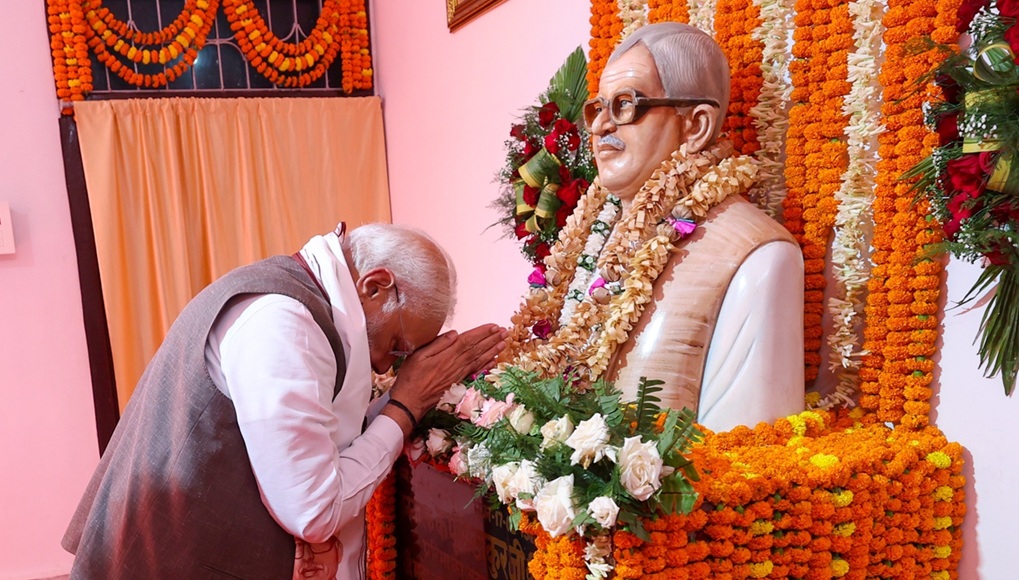
Samastipur: Prime Minister Narendra Modi kickstarted his Bihar election campaign on Friday from Karpoori Village in Samastipur — the birthplace of socialist icon and Bharat Ratna awardee Karpoori Thakur. The rally, attended by thousands, set the political tone for the National Democratic Alliance (NDA) ahead of the state assembly polls.

In his 45-minute address, Modi attacked the opposition over “jungle raj,” corruption, and dynasty politics, while highlighting his government’s achievements. The Prime Minister also praised Chief Minister Nitish Kumar and publicly reaffirmed NDA unity by inviting him to speak on stage — a gesture seen as both symbolic and strategic.
Why Karpoori Village? The Political Message Behind the Choice
Modi’s choice of Karpoori Village was not just about paying floral tribute to Karpoori Thakur’s statue — it was a calculated political move aimed at Bihar’s most influential vote bank: the Extremely Backward Classes (EBCs).

“Launching the campaign from Samastipur was a symbolic, social, and geographical strategy,” said political analyst Dr. R.K. Mishra. “Karpoori Thakur represents social justice and EBC identity in Bihar. By awarding him the Bharat Ratna, Modi has cemented the message that Karpoori’s legacy belongs to the NDA.”
The Political Strategy in Three Layers
1. Strengthening the EBC Equation
According to the caste survey, EBCs constitute nearly 36% of Bihar’s population — the largest vote bank. Modi linked his and Nitish Kumar’s rise to Karpoori’s legacy, saying, “It is his blessing that people like us, who come from poor and backward families, are standing on this stage.”
Dr. Mishra noted that this was an attempt to strengthen the NDA’s EBC–OBC–upper caste coalition against the RJD’s traditional Muslim-Yadav (MY) base.
2. Attacking the RJD’s ‘Stolen Legacy’
The Prime Minister accused the RJD of “stealing” Karpoori Thakur’s title of Jananayak (People’s Leader). “Those who are on bail… their habit of stealing is such that they are now engaged in stealing Karpoori Babu’s name,” Modi said. The comment was aimed at portraying the RJD as family-centric and anti-EBC.
3. Local Reaction — Respect or Politics?
While many locals expressed pride over the first-ever visit by a sitting Prime Minister, others saw political opportunism.
Karpoori Thakur’s granddaughter, Jagriti Thakur, who is contesting from Morwa on a Jan Suraj ticket, remarked, “It’s easy to invoke Karpuriji’s name, but difficult to follow his ideals. True respect will come when Samastipur’s factories reopen and migration stops.”
An elderly villager said, “It’s good that Delhi remembered us, but real respect will come when our youth can work here.”
Samastipur: JDU’s Stronghold and ‘Gateway to Mithila’
Dr. Mishra calls Samastipur the “Gateway to Mithila” — politically influential across Darbhanga, Madhubani, Muzaffarpur, and Begusarai. “By holding a rally here, Modi has tried to influence more than 100 assembly constituencies,” he said.
Political observer Arun Pandey noted that Modi is focusing on JDU’s weak spots. “The BJP knows Nitish Kumar’s health and succession issues. Modi is personally focusing on JDU’s lost seats to consolidate the NDA’s EBC base and revive cadre unity,” he said.
In 2020, the NDA lost five out of ten seats in Samastipur, with narrow margins in constituencies like Morwa and Vibhutipur. Modi’s rally is seen as an attempt to reverse that trend.
Speech Decoded: Five Key Takeaways from Modi’s Address
- Karpoori’s Legacy = NDA’s Legacy: Modi positioned the NDA as the true heir of Karpoori’s ideals, linking the Bharat Ratna, EBC reservations, and promotion of regional languages to his government’s policies.
- ‘Lantern vs Flashlight’ Moment: In a symbolic gesture, Modi asked people to switch on their mobile flashlights and said, “When there is so much light, do you need a lantern?” — a clear jab at RJD’s poll symbol.
- ‘Makhana Diplomacy’: Modi praised Mithila’s Makhana (fox nuts) and mentioned the creation of the Makhana Board, appealing to local farmers.
- Double Engine Praise: He lauded Nitish Kumar’s welfare schemes, portraying the NDA as the face of “good governance versus jungle raj.”
- Targeting RJD Rule: Modi described RJD’s tenure as an “industry of extortion, murder, and ransom,” claiming that the NDA had “broken the back of Naxalism.”
What Modi Avoided: The Silent Gaps
Despite extensive local references, the Prime Minister avoided two key local issues — the closure of Samastipur’s Rameshwar Jute Mill, which once employed over 3,000 workers, and the long-pending Bhola Talkies overbridge project that causes daily traffic chaos.
Political analysts say the omissions indicate a focus on symbolism and legacy over ground-level concerns.
The Symbolism vs Reality Debate
Modi’s rally was heavy on symbolism — invoking Karpoori Thakur’s legacy and the imagery of “light defeating darkness.” However, critics argue that unemployment and industrial decline remain unaddressed.
“The NDA wants the name of a people’s leader but ignores people’s problems,” said a local RJD worker.
Whether Samastipur’s voters prioritize “Karpoori’s name” or “the jute mill’s job” will decide the real impact of this rally.
Modi’s Twin Political Goals in Bihar
Political observers say Modi’s Samastipur rally had a dual purpose:
- Repairing 2020 Damage: To heal the rift caused by Chirag Paswan’s “vote-cutter” campaign that hurt JDU’s performance.
- Future Strategy: To project Modi — a leader from the EBC (Teli) community — as the natural heir to Nitish Kumar’s EBC base, positioning the BJP as Bihar’s dominant political force in the post-Nitish era.
Senior journalist R. Kaushalendra said, “By starting from Karpoori Thakur’s village, Modi has sent a clear message — this time, the NDA wants not just victory but dominance in Bihar politics.”