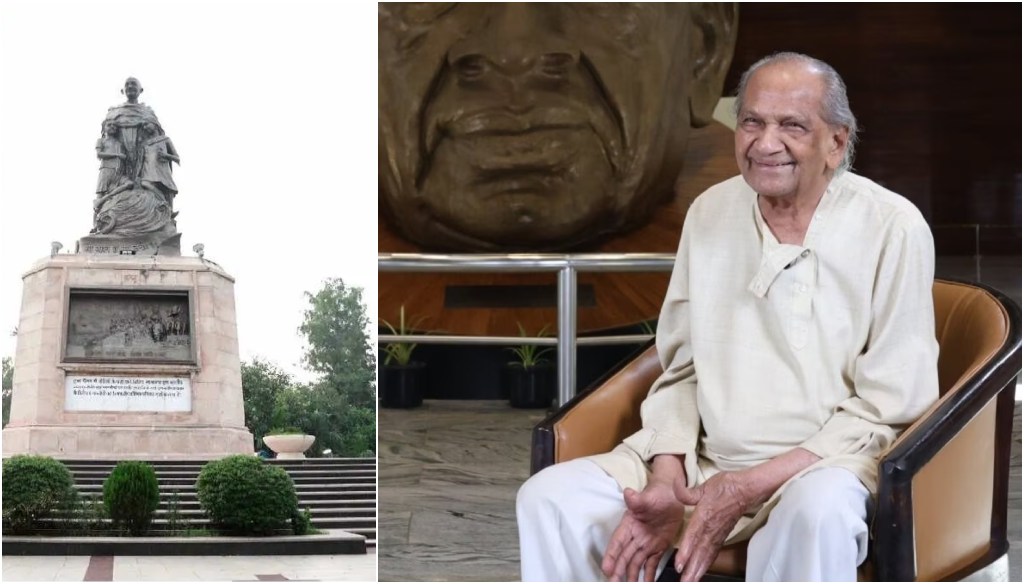
Patna: Ram Sutar, one of India’s most celebrated sculptors whose works include some of the country’s most recognisable public monuments, has died at the age of 100 after a prolonged illness.

Sutar was best known in Bihar for the towering bronze statue at Gandhi Maidan in Patna, often described as the world’s tallest bronze statue of Mahatma Gandhi. The monument, which stands 72 feet tall on a 24-foot base, was designed by Sutar in collaboration with his son, Anil Sutar, and was launched by Bihar chief minister Nitish Kumar on February 15, 2013.
Deeply influenced by Mahatma Gandhi, CM Nitish has frequently cited Gandhian ideals in public life, including his decision to enforce complete prohibition in Bihar. His government also ensured that Gandhi’s “seven social sins” were displayed in state offices, alongside commissioning the large-scale statue in Patna.

Born on February 19, 1925 in Gondur village in Maharashtra’s Dhule district, Sutar trained at the Sir J.J. College of Art in Mumbai, where he was awarded a gold medal for excellence. Over a career spanning several decades, he emerged as a defining figure in modern Indian sculpture.
Among his most notable works is the Statue of Unity in Gujarat, depicting Sardar Vallabhbhai Patel, India’s first deputy prime minister and home minister. He also sculpted the statue of Mahatma Gandhi in a meditative pose in the Parliament complex and the equestrian statue of Chhatrapati Shivaji Maharaj.
Sutar was honoured with the Padma Shri and the Padma Bhushan for his contribution to art and culture.
Paying tribute, Anjani Kumar Singh, director general of the Bihar Museum, said Sutar was “an international-level sculptor” whose works would endure across generations. “The Gandhi statue at Gandhi Maidan is among his most significant creations. With his passing, India and the world have lost a great sculptor,” he said.