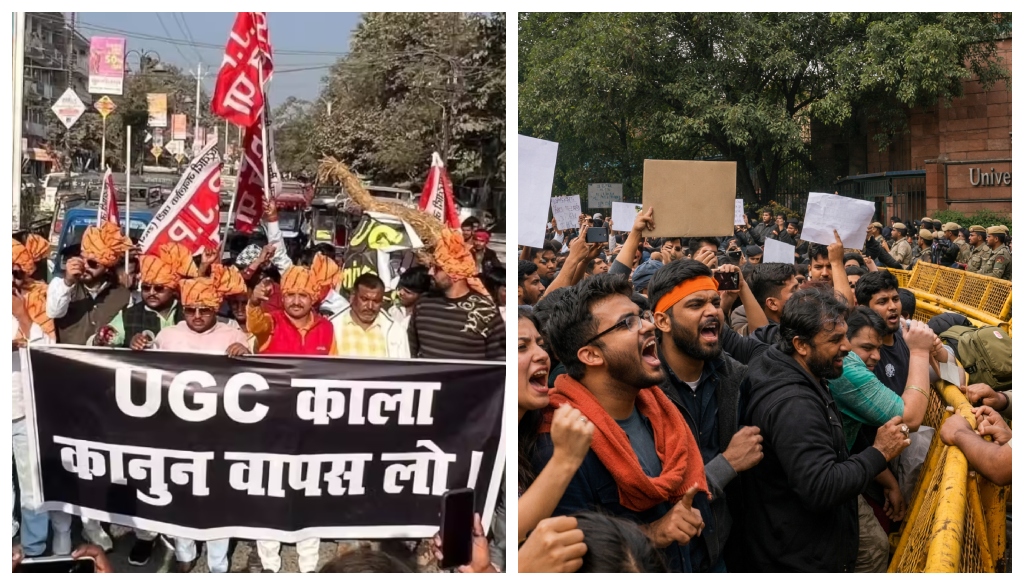
New Delhi: Protests against the University Grants Commission’s newly notified UGC Regulations 2026 are intensifying across the country, with critics alleging that the rules could deepen social divisions within higher education. What began as student-led opposition has now acquired a sharper political edge, with dissent emerging even within the ruling Bharatiya Janata Party (BJP).

The controversy escalated after Alankar Agnihotri, a Uttar Pradesh Public Service Commission (UPPSC) officer, resigned from his post in protest against the regulations. In his resignation, Agnihotri said the rules were unacceptable and cited what he described as an insult to the Shankaracharya tradition as one of the reasons for stepping down.
The regulations have also drawn criticism from public figures, including poet and author Kumar Vishwas, who described the new framework as unjust and harmful to social harmony.

Political unease has grown within the BJP, particularly in Uttar Pradesh. Party leaders in Raebareli and Lucknow have resigned from their posts, citing opposition to the UGC rules. Prateek Sharan Singh, an MLA and son of BJP leader Brij Bhushan Sharan Singh, has also publicly expressed his disagreement with the regulations.
Senior BJP leader and former Union minister Kalraj Mishra joined the chorus of criticism, warning that the rules could create discrimination and division among students. He said there should be no caste-based discrimination in educational institutions and urged the government to reconsider the regulations in the interest of social cohesion.
In a related development, Shyam Sundar Tripathi, vice-president of the BJP Kisan Morcha in Raebareli, resigned from his organisational post in protest. In a letter addressed to Prime Minister Narendra Modi, Tripathi described the regulations as a “black law”, alleging that they were divisive and dangerous for society.
Student protests have meanwhile continued to gather momentum. Large groups of students demonstrated outside the UGC office in Delhi, prompting the deployment of heavy police presence. Protesters said the regulations would institutionalise discrimination and undermine social harmony on university campuses.