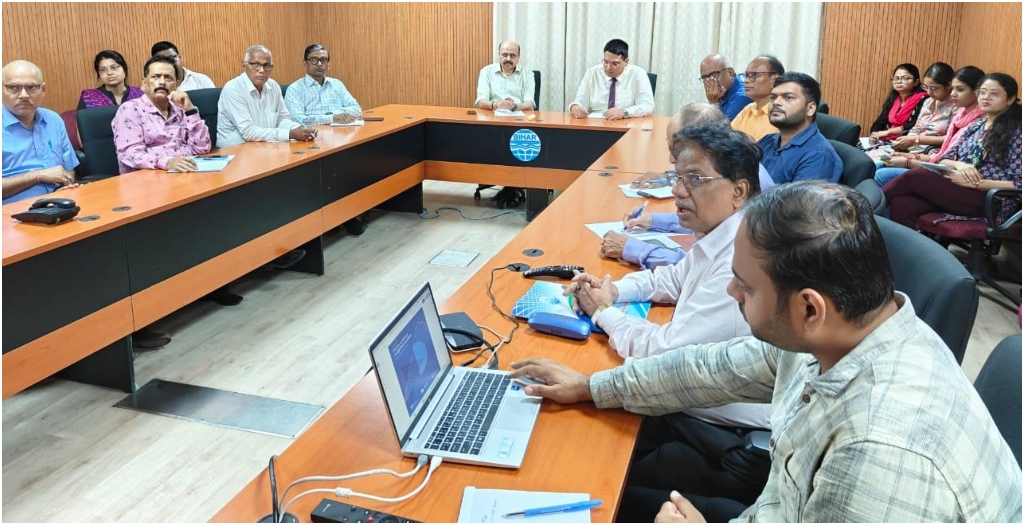
Patna: People around the world observed World Ozone Day on Monday, a day marked every year on September 16 to raise awareness about the importance of the ozone layer — a protective shield in the Earth’s atmosphere that blocks harmful ultraviolet (UV) rays from the Sun. This year’s theme, “From Science to Global Action,” focused on how global cooperation and scientific research have helped repair the ozone layer and reduce the use of harmful chemicals. In Bihar, a special seminar was held by the Bihar State Pollution Control Board on Tuesday, where scientists, government officials, and environmental experts came together to discuss the ongoing efforts to protect the ozone layer.

The Chairman of the Board, Dr D.K. Shukla, and Member Secretary Neeraj Narayan, were among the key participants in the event. They were joined by several scientists and engineers who explained how the ozone layer works, what causes it to become thinner, and how everyone can help protect it. Scientific Advisor S.N. Jaiswal delivered a detailed talk on the subject, explaining that the Earth’s atmosphere has different layers, and the ozone layer is found in the stratosphere, where it plays a crucial role in protecting life on Earth. He warned that human activities, especially the use of chemicals like chlorofluorocarbons (CFCs), continue to damage the ozone, even though global rules have helped reduce their use.
Jaiswal also spoke about the Montreal Protocol, a major international treaty signed in 1987 to reduce the use of ozone-depleting substances. India has followed this with its own law, the Ozone Depleting Substances (Regulation and Control) Rules, 2000, which controls the production, sale, and use of harmful chemicals. Thanks to these global and national efforts, recent scientific reports now show that the ozone layer is slowly recovering. According to the latest research, the ozone levels are expected to return to what they were in 1980 by 2040 globally, 2045 in the Arctic, and 2066 over Antarctica. While this is good news, experts warned that the recovery process can be affected if harmful substances are not strictly controlled.

Other scientists at the event, including Dr Naveen Kumar, Arun Kumar, Nalini Mohan Singh, and Dr Rachna Singh, also took part in discussions. They stressed the importance of continuing education and awareness, especially among students and the general public. At the end of the programme, Member Secretary, Neeraj Narayan gave a vote of thanks and called the Montreal Protocol “a success story” that shows how the world can come together to solve major environmental problems. He reminded everyone that while governments and scientists have done a lot, every individual also has a role to play in protecting the ozone layer — from using eco-friendly products to spreading awareness in their communities.