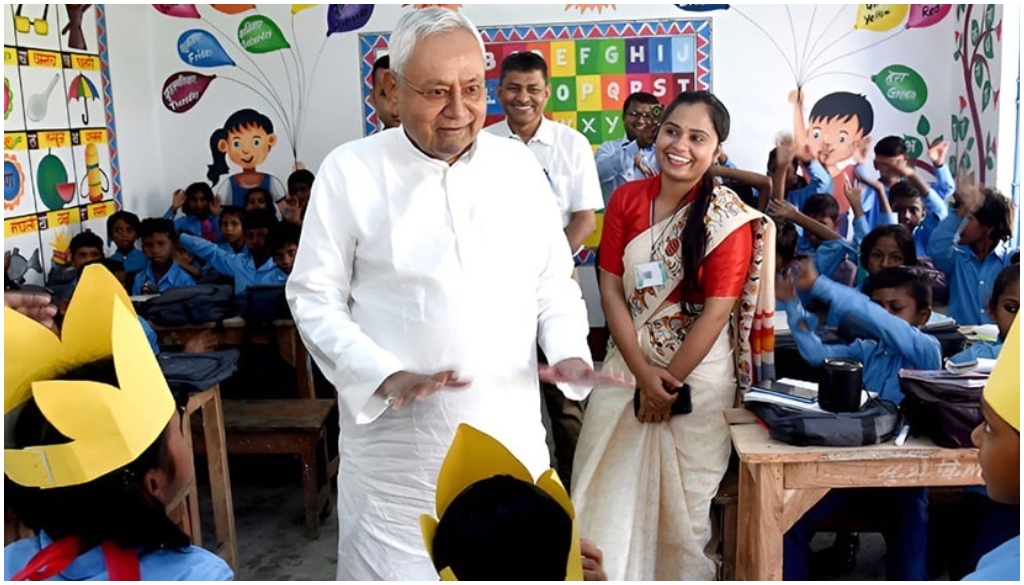
Patna: Bihar Chief Minister Nitish Kumar on Sunday reflected on the state’s transformation in the field of education since 2005, sharing a detailed post on his official Instagram handle.

In his message, CM highlighted what he described as a “remarkable turnaround” in Bihar’s education system, noting that the number of government teachers has now reached six lakh. Of these, 3.68 lakh teachers appointed through local bodies are in the process of being regularised through competency tests.
The Chief Minister contrasted the current scenario with the dire state of education before 2005. “Back then, government schools were in ruins, classrooms lacked basic furniture, and teacher shortages were acute,” he wrote. “Between 1990 and 2005, recruitment was almost negligible — there was just one teacher for every 65 students, and over 12 percent of children were out of school.”

वर्ष 2005 से पहले बिहार में शिक्षा का हाल बहुत बुरा था। छात्र-छात्राएं स्कूल नहीं जा पाते थे। सरकारी स्कूलों के भवन जर्जर हो चुके थे। राज्य में प्राथमिक विद्यालयों की संख्या बहुत कम थी। शिक्षा के लिए बुनियादी ढांचे का घोर अभाव था। स्कूलों में बच्चों को बैठने के लिए बेंच-डेस्क… pic.twitter.com/nvuPmz0DMD
— Nitish Kumar (@NitishKumar) November 2, 2025
CM Nitish accused previous governments of neglecting education, saying academic sessions were so delayed that students often took five years to complete their graduation. “Those in power had made a mockery of education,” he added. “Instead of expanding schools, they were content with introducing ‘shepherd schools’.”
After assuming office on November 24, 2005, Kumar said his government made education reform a top priority. “We began by increasing the education budget every year,” he noted. The state’s education budget, which stood at just Rs 4,366 crore in 2005, has now risen to Rs 60,964.87 crore in 2025–26 — nearly 22 percent of Bihar’s total budget.
Since 2005, the number of schools has grown from 53,993 to 75,812, with nearly 98 percent of the state’s hamlets now covered by government schools. High schools have been established in all panchayats, and education up to Class 12 is now available locally, especially benefiting girls who previously had to travel long distances.
In 2024 alone, 238,744 teachers were recruited through the Bihar Public Service Commission, followed by the appointment of 36,947 head teachers and 5,971 headmasters in 2025 — one of the largest recruitment drives in the country.
The Chief Minister also highlighted several initiatives aimed at improving access and quality of education. The Unnayan Bihar Yojana introduced digital learning in classrooms, while schemes such as free uniforms (2006–07) and bicycles for girls (2008) boosted female enrolment. The bicycle scheme, later extended to boys in 2010, received international recognition and was replicated in several Indian states.
“As a result of these sustained efforts,” CM Nitish wrote, “the number of female students in matriculation and intermediate classes now surpasses that of male students — a testament to Bihar’s progress in education.”
CM concluded his post by commending teachers for their “tireless contribution” and reaffirming his government’s commitment to improving educational standards across Bihar.