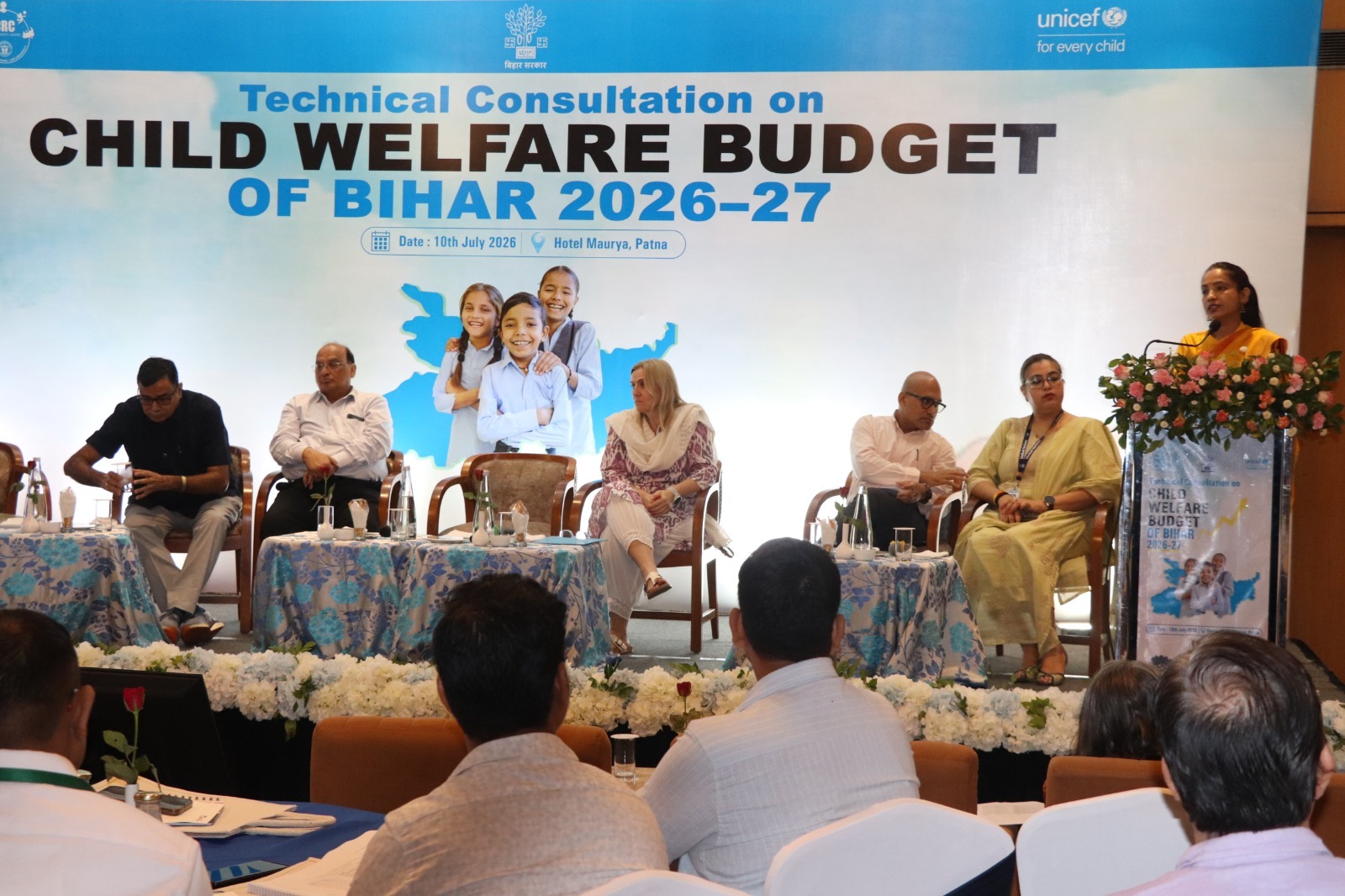
Patna: The Bihar government, in collaboration with UNICEF and the Child Rights Centre of Chanakya National Law University (CNLU), held a technical consultation on the Child Welfare Budget 2026–27 on Friday to review strategies for strengthening child-focused public spending.

The consultation brought together senior officials from more than 15 government departments, development partners, finance experts and academic institutions to discuss improvements in the design, classification, allocation and utilisation of the state’s Child Welfare Budget.
Government Emphasises Outcome-Oriented Budgeting

Addressing the gathering, Rachana Patil, Secretary (Expenditure), Finance Department, Government of Bihar, said the consultation provided an opportunity for departments to identify implementation challenges and strengthen child-focused budgeting through evidence-based approaches.
She said Bihar has increased investment in children since introducing the Child Welfare Budget in 2013–14, reflecting the state’s focus on health, nutrition, education and child protection. Patil added that higher budget allocations should be accompanied by regular assessment of expenditure efficiency and measurable outcomes.
UNICEF Calls For Stronger Public Finance Reforms
Monika Nielsen, Chief of UNICEF Bihar Field Office, said Bihar had made progress in prioritising children’s issues and that further strengthening the Child Welfare Budget could improve outcomes in health, nutrition, education, protection and social development.
She emphasised the need to move beyond budget analysis towards reforms that improve planning, expenditure efficiency and accountability, while reaffirming UNICEF’s support for the state’s child-centred budgeting initiatives.
CNLU Highlights Role Of Research
S. P. Singh, Registrar of Chanakya National Law University, said constitutional and legal safeguards for children should be supported by adequate public investment.
He stressed that evidence-based research and empirical data should guide policymaking and budgeting for children, adding that the university would continue to support the state government and UNICEF through research, policy inputs and capacity-building initiatives.
Budget Analysis And Best Practices Discussed
The technical sessions began with a presentation by Abhay Kumar, Social Policy Specialist at UNICEF Bihar, who presented findings from the Government of Bihar’s Child Welfare Budget Analysis 2026–27.
The presentation reviewed trends in budget allocation, expenditure patterns and sectoral priorities over the past decade while identifying opportunities to improve budget classification, expenditure tracking and outcome measurement.
Soumen Bagchi, Financing for Children Specialist at UNICEF India Country Office, also presented national and international practices in child-responsive public finance and discussed approaches to strengthening planning, budgeting and financial monitoring.
Departments Review Existing Budget Framework
A department-led discussion, moderated by Rachana Patil, examined existing budgeting practices, identified gaps in classification and utilisation, and considered recommendations to make Bihar’s Child Welfare Budget more responsive to children’s needs.
Participants noted that children constitute nearly half of Bihar’s population and said sustained improvements in health, nutrition, education and child protection would require stronger public financial planning, efficient resource allocation and improved expenditure tracking.
The programme concluded with a vote of thanks delivered by Sugandha Sinha, faculty member at Chanakya National Law University, Patna.