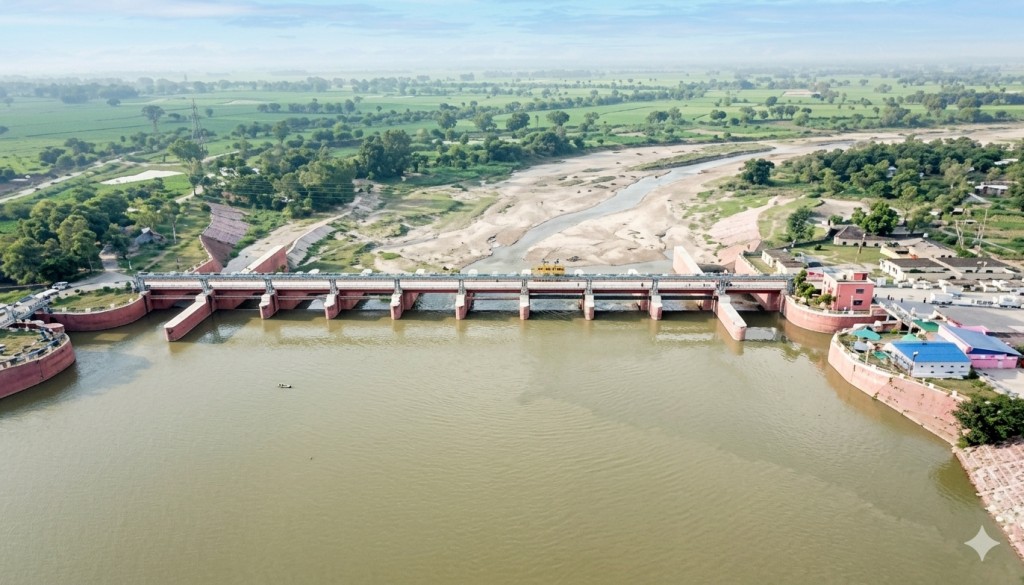
Patna/Gaya:The Dhadhar Irrigation Project in Gaya district is providing irrigation support to farmers across Gaya, Nawada and Jehanabad, helping improve water availability for agricultural activities during the kharif season.

The project centres on a barrage constructed on the Dhadhar river at Sohjana Donaiya in Fatehpur block. The facility was inaugurated in 2020 by then chief minister Nitish Kumar.
According to project details, water from the barrage is channelled through a network of canals and distributaries to agricultural areas in the region.

Irrigation coverage and current operations
Officials said the original Tilaiya-Dhadhar Diversion Scheme envisaged the transfer of 1.40 lakh acre-feet of water from the Tilaiya reservoir through canals to the Dhadhar river system.
The project was designed to provide irrigation facilities across around 31,700 hectares in Gaya and Nawada districts. At present, water available through the Dhadhar river supports irrigation in approximately 6,900 hectares through the main canal and associated distribution network.
Authorities have stated that restoring irrigation facilities in the remaining command area of about 24,800 hectares would require additional water releases from the Tilaiya reservoir in Jharkhand.
Long history of the project
The origins of the project date back to the 1960s and 1970s. Historical accounts indicate that former Jehanabad MP Satyabhama Devi played a key role in advocating for the scheme after recurring drought conditions affected the region.
The proposal was reportedly finalised in 1974, and the foundation stone for the barrage was laid in October 1984 by then Bihar chief minister Chandrashekhar Singh.
The project was initially expected to be completed by 1990.
Impact of Bihar-Jharkhand bifurcation
Implementation of the project faced significant delays following the creation of Jharkhand in 2000.
Since the original plan depended on water from the Tilaiya reservoir, which is located in Jharkhand, inter-state issues affected the project’s progress and limited its intended operational capacity.
The matter also became the subject of legal and public advocacy efforts over the years. The project was later included in the Ninth Five-Year Plan, with financial support from the Union government.
Benefits during the kharif season
Departmental sources said that during the kharif season, around 739 cusecs of water are released from the Sohjana Donaiya barrage into connected canals and distributaries.
This water supports agricultural activities in the command area and provides irrigation benefits to farmers cultivating seasonal crops.
Future potential
Officials have said the project has the potential to expand irrigation coverage if additional water becomes available from the Tilaiya reservoir. Plans linked to hydropower generation have also been discussed as part of the broader project framework.
For farmers in parts of south Bihar, the barrage continues to serve as an important source of irrigation, particularly during the monsoon cropping season.