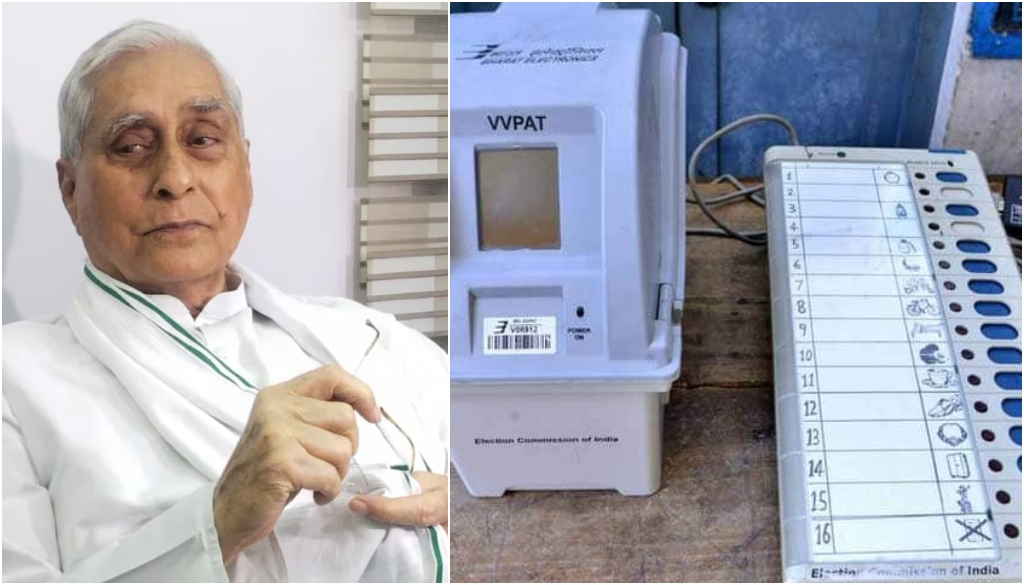
Patna: Allegations by senior RJD leader Jagdanand Singh that every electronic voting machine (EVM) in the recent elections contained “25,000 pre-loaded votes” have no procedural or technical basis, according to statutory records and established Election Commission protocols.

As per a statement issued by Election Commission of India (ECI) on Tuesday, EVMs used in Indian elections do not contain WiFi, Bluetooth, internet capability or any form of external connectivity, making remote or digital manipulation impossible. “Before voting begins, each machine displays zero votes for every candidate, and a mandatory mock poll is conducted at every booth in the presence of representatives from all political parties. Once the mock poll ends, the machine is reset and the mock poll certificate is jointly signed by party agents — including those of the RJD,” the ECI said.
The allocation of EVMs undergoes two rounds of randomisation. The first, at the district level, assigns machines to assembly constituencies; the second, carried out at the constituency level, allots machines to individual polling stations. “These processes take place in the presence of political party agents, ensuring no one can predict which machine will go to which booth,” the ECI has claimed.

The ECI further stated: “Political representatives remain present throughout the stages of sealing, dispatch, polling and storage of EVMs. Strong rooms are secured under CCTV surveillance with seals bearing the signatures of all party agents. No broken seal, irregularity or formal objection was recorded by the RJD at any point.”
“Each EVM is used alongside a voter-verified paper audit trail (VVPAT) unit, enabling voters to confirm their choice. Random VVPAT counts in every constituency serve as a statistical check, and no mismatches were reported between EVM and VVPAT tallies.”
The ECI further claimed that no substantive evidence has been presented by Singh to support his allegation. On the contrary, the RJD’s own polling agents signed the mock poll certificates, Form 17C (the statutory record of votes cast) and sealing documents without raising objections — contradicting the claims now being made.