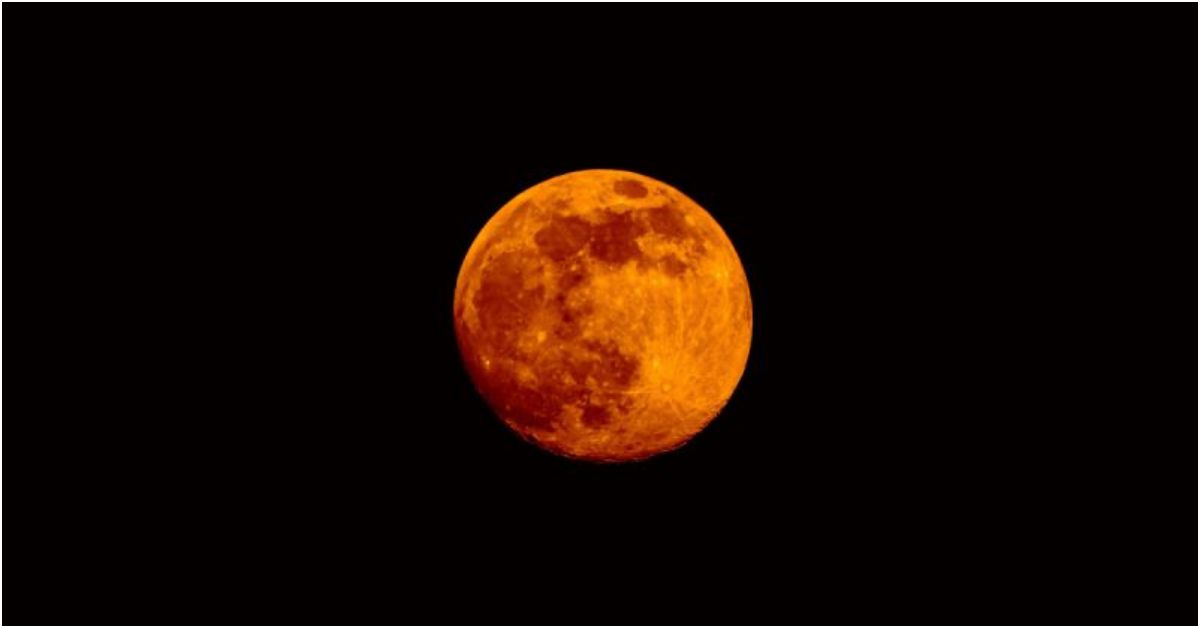
Patna: A total lunar eclipse will coincide with Holi on March 3, offering skywatchers across parts of India the chance to witness a so-called “blood moon” as the full Moon passes into the Earth’s shadow.

The eclipse, which occurs when the Earth moves directly between the Sun and the Moon, will begin at 3.20pm and end at 6.57pm, according to Mahant of Delhi’s Kalkaji Temple. During totality, the Moon is expected to take on a reddish hue – a phenomenon popularly known as a blood moon.
Where it will be visible

If skies remain clear, the eclipse will be visible to the naked eye without the need for special glasses. Astronomers say viewing conditions are likely to be most favourable in India’s north-east, including Assam, Arunachal Pradesh, Manipur, Nagaland and Mizoram. It is also expected to be visible, though potentially less clearly, from major cities such as Delhi, Mumbai, Chennai and Kolkata.
Scientists stress that a lunar eclipse is a routine astronomical event and poses no risk to health or daily life.
Why the Moon turns red
The Moon appears red during a total lunar eclipse because sunlight reaching it has passed through the Earth’s atmosphere. Shorter-wavelength blue light is scattered in all directions – a process known as Rayleigh scattering, which also makes the sky appear blue – while longer-wavelength red light bends through the atmosphere and reaches the Moon.
The exact shade depends on atmospheric conditions. Higher levels of dust or pollution can block more light, producing a darker red . Clearer skies allow more light through, giving the Moon a brighter, orange tint.
Total lunar eclipses do not occur every full moon because the Moon’s orbit is slightly tilted relative to the Earth’s path around the Sun. As a result, the three bodies rarely align perfectly. In several upcoming eclipses, the Moon will only partially enter the Earth’s shadow.
Religious interpretations and Sutak period
While scientists describe the eclipse as a natural celestial alignment, religious scholars attach spiritual significance to the event. In Hindu tradition, a “Sutak” period – considered inauspicious – begins before the eclipse and lasts until it ends.
According to religious authorities, the Sutak period will begin at 9.39am on March 3, roughly nine hours before the eclipse. During this time, devotees are advised to refrain from performing rituals or starting new ventures. Temples often suspend regular worship.
Chanting mantras and engaging in silent or mental worship are regarded by some as appropriate practices during the eclipse. After it concludes at 6.57pm, devotees traditionally sprinkle Ganga water around the home, bathe and give to charity before celebrating Holi the following day.
Some astrologers suggest that people born under Leo, Virgo and Aquarius should exercise caution during the eclipse, while Aries and Gemini may experience favourable outcomes. Such claims, however, are not supported by scientific evidence.
Mythological roots
Traditional belief traces eclipses to a story from Hindu mythology in which the demon Rahu consumed nectar meant for the gods during the churning of the ocean. The deity Vishnu is said to have severed his head; Rahu’s head and torso, known as Ketu, were thereafter believed to pursue and periodically “swallow” the Sun and Moon, causing eclipses.
For many, the eclipse will be both a scientific spectacle and a moment of spiritual reflection, unfolding just hours before the festival of colours begins.