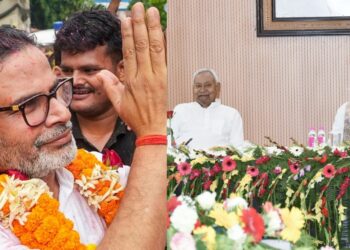
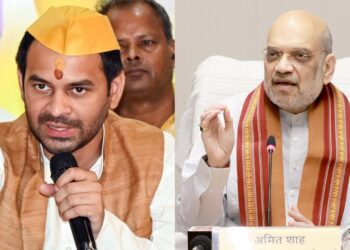
Patna: Former Bihar Chief Minister and JD(U) president Nitish Kumar has once again triggered political debate in Bihar after reportedly asking Deputy Chief Minister Vijay Kumar Choudhary to brief him in detail about the functioning of the state government.

“Come in the evening and explain everything one by one about what is happening,” Nitish Kumar reportedly told Vijay Kumar Choudhary during a closed-door meeting that lasted around 30 minutes on May 28.
The remarks have fueled speculation over whether Nitish Kumar is continuing to exercise significant control over the Bihar government despite stepping down as Chief Minister and moving to national politics.

Political observers see multiple messages in Nitish Kumar’s statement. The first is that while he may no longer hold the Chief Minister’s chair, he continues to play a central role in the functioning of the NDA government in Bihar. Leaders of the ruling alliance had earlier stated that the government under Chief Minister Samrat Choudhary would function under Nitish Kumar’s guidance.
Analysts believe Nitish Kumar’s comments also signal that JD(U)’s policies and political agenda cannot be sidelined in the new power arrangement. Vijay Kumar Choudhary, considered a close aide of Nitish Kumar, is widely seen as a bridge between the government and the JD(U) leadership.
The timing of the meeting has also attracted attention as it took place while Chief Minister Samrat Choudhary was on a Delhi visit, where he was scheduled to meet senior constitutional authorities and interact with Bihar cadre IAS officers.
Political circles in Bihar interpret Nitish Kumar’s public remarks as a message to the BJP leadership that his influence over Bihar’s bureaucracy and governance structure remains intact despite his shift to the Rajya Sabha and national politics.
There is also speculation that Nitish Kumar may be assessing the mood within JD(U) itself, especially among ministers and MLAs adapting to the new political equations following the leadership transition in Bihar.
The development has also sparked a debate over whether a former Chief Minister and party president can constitutionally seek reports from serving ministers of the government.
Constitutional experts point out that under Article 164(2) of the Constitution, the Council of Ministers is collectively responsible to the Legislative Assembly, and administratively the Chief Minister remains the head of the government. Officially, only the sitting Chief Minister has the authority to seek formal reports and reviews from ministers.
Since Nitish Kumar is currently a Rajya Sabha MP and JD(U) president, he does not hold any executive authority in the state government. Experts argue that any formal sharing of confidential government files or classified documents with a non-executive political leader could technically violate the oath of secrecy taken by ministers.
However, political analysts note that coalition governments often function through informal coordination mechanisms. As JD(U) chief, Nitish Kumar can politically seek feedback from ministers belonging to his party regarding the implementation of the party’s agenda within the government.
Senior leaders across political parties routinely remain involved in informal consultations and policy discussions even after leaving executive office, analysts added.
The situation has also revived memories of the political tensions during the tenure of former Chief Minister Jitan Ram Manjhi in 2014-15, when Nitish Kumar was widely accused by opponents of exercising remote control over the government after stepping down from office.
At the time, Manjhi had publicly claimed that even transfer and posting decisions required approval from Nitish Kumar’s residence. The political conflict eventually escalated after Manjhi began taking independent decisions, leading to a major power struggle within JD(U).
While political observers see some similarities between the current situation and the Manjhi era, they believe the present circumstances are significantly different because the current NDA arrangement was formed with an openly acknowledged leadership role for Nitish Kumar within the alliance.