The P.G. (postgraduate) Department of Ancient Indian and Asian Studies at Magadh University has commenced large-scale archaeological excavation at the ancient site of Dubba (Bhurha) under Gurua police station in Gaya district.

The excavation marks the first systematic archaeological project undertaken by the university and is being viewed as a significant development in its academic and research activities.
Researchers said the site has considerable archaeological potential, with visible remains including brick-built structures, sculptures, ancient water bodies and habitation zones spread across a large area.

Site may have Buddhist and Hindu religious significance
Preliminary observations suggest the site may once have functioned as a Buddhist monastic centre along with Hindu religious establishments.
Located near an ancient rivulet locally known as Bhurha, the settlement appears to have developed around interconnected water bodies and religious structures.
Archaeologists said several sculptures of predominantly Buddhist character recovered from the mound indicate the possible sacred significance of the area.
The site is also linked to local traditions associated with the life of Gautama Buddha and ancient epic narratives. Researchers believe scientific excavation may help verify the historical basis of these traditions.
Excavation approved by Archaeological Survey of India
Before excavation began, the department carried out surface exploration, aerial photography, land surveys, topographical mapping and documentation of visible antiquities.
Following these studies, a detailed excavation proposal was submitted to the Archaeological Survey of India (ASI) on September 20 last year through the Directorate of Archaeology under Bihar’s Department of Art, Culture and Tourism.
The proposal was recommended by Magadh University Vice-Chancellor Prof. Shashi Pratap Shahi.
The ASI granted excavation permission in February this year. The project is being led by Shanker Sharma as Director of Excavation and Alaka Mishra as Co-Director.
Concerns over encroachment and damage
Faculty members involved in the project have raised concerns over damage to the archaeological mound due to soil cutting, mining activities and encroachment.
Despite its archaeological significance, the site currently does not have protected status.
Researchers also noted that Dubba (Bhurha) appears to lie along an ancient pilgrimage route connecting Bodh Gaya and Sarnath, both major centres of Buddhism. The surrounding region contains several unexplored mounds and antiquities.
Students receive field training at excavation site
The excavation is also functioning as a field training programme for postgraduate and doctoral students.
Students are receiving practical instruction in excavation techniques, documentation, archaeological photography, trench management, pottery analysis and heritage interpretation.
Around 30 faculty members, researchers and students are currently stationed at the site and participating in excavation work.
Students from Nava Nalanda Mahavihara are also taking part in the project.
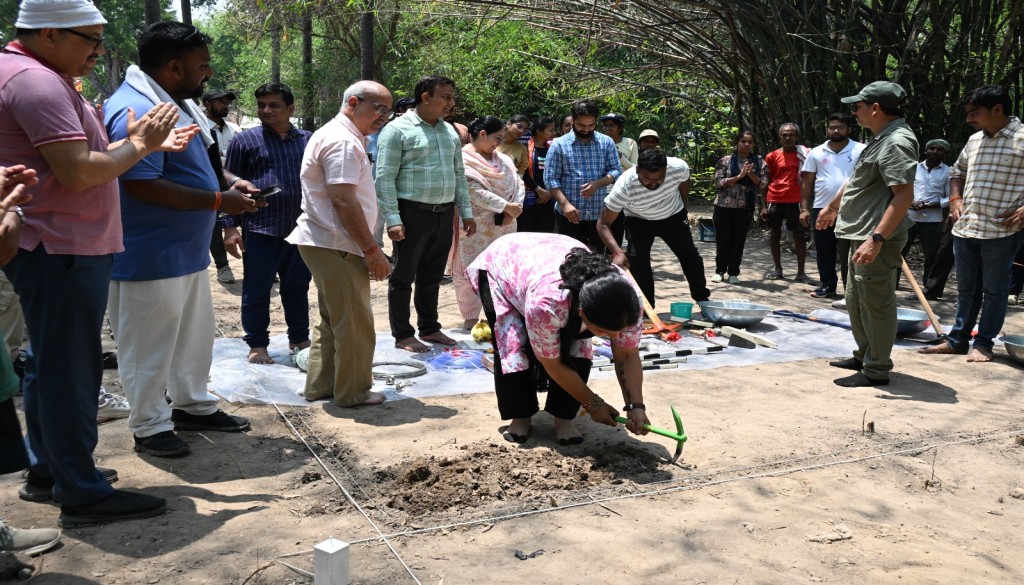
Faculty members attend formal launch
The formal commencement of excavation was attended by faculty members and researchers including Alaka Mishra, Chandra Prakash, Alok Ranjan, Anup Kumar Bhardwaj, Vijay Kant Yadav and Janmejay Singh, along with PhD scholars from the department.
Prof. Sushil Kumar Singh, former professor of the department, was also present at the site.
Researchers said the excavation could contribute to a better understanding of ancient settlement systems, Buddhist expansion, pilgrimage networks and religious interaction in the Magadh region.