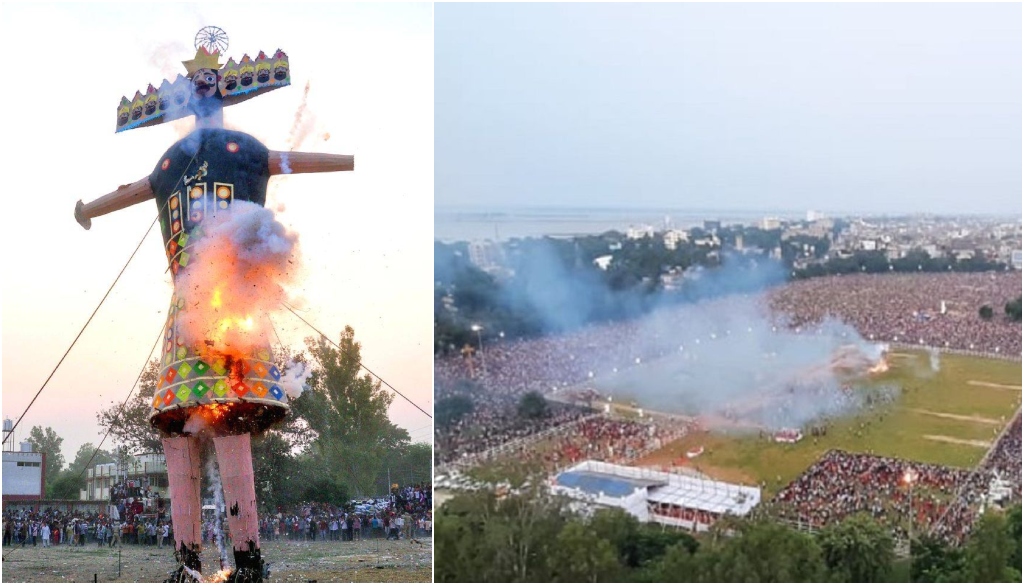
Patna: The now-iconic tradition of burning Ravana’s effigy in Patna is a relatively recent addition to the city’s cultural calendar. Contrary to popular belief, the practice did not exist in Bihar before independence. It was first introduced in 1955, eight years after India gained freedom, by migrants who had arrived from Pakistan following the Partition.

Historical records indicate that the inaugural event drew a modest crowd of around 300 people. Over the decades, the festival has grown in scale and prominence, evolving into a grand celebration at Gandhi Maidan in the heart of Patna.
A migrant initiative

Following the upheavals of 1947, hundreds of Hindus and Sikhs from Sindh and Lahore settled in Patna. Many brought with them cultural practices from their former homes, including the ritual of burning Ravana effigies. In 1954, Bakshi Ram Gandhi and his brother Mohan Lal Gandhi, who had migrated from Lahore, founded the Shri Dussehra Committee Trust to formalise the event. The first Ravana effigy burning took place the following year.
T.R. Mehta, Radhakrishna Malhotra, O.P. Kochhar, P.K. Kochhar, and Kishan Lal Sachdev were appointed as office bearers of the trust. The 1955 event was held near R-Block Chowk, with the accompanying Ramlila staged near Harding Park. Funds for the first celebration, totaling Rs 300, were collected from the migrant community. The event was later shifted to Gandhi Maidan, where it has been celebrated almost every year since.
Political patronage and grandeur
Although the festival was modest in its early years, it gained substantial prominence in 1990 under the support of then-Chief Minister Lalu Prasad Yadav. He was the first sitting Chief Minister to attend the event, and his patronage transformed the Ravan Dahan into a major cultural spectacle, solidifying its place in Patna’s annual festivities.
In its seven-decade history, the Ravana effigy burning has been held consistently, only missing four years. Today, the festival stands as a testament to the city’s evolving cultural landscape and the enduring influence of migrant communities in shaping local traditions.