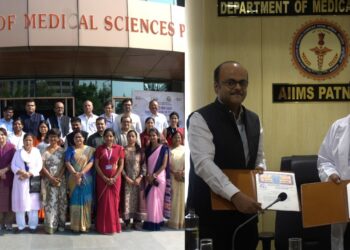
Patna: The Ministry of Road Transport and Highways (MoRTH) has signed a memorandum of understanding with the Indian Institute of Technology Patna to enhance technological collaboration on tunnel safety and hill slope protection along India’s national highways.

The agreement was signed by Prof T N Singh, director of IIT Patna, and Dr Amit Kumar Verma, head of the institute’s civil engineering department, alongside senior officials from the transport ministry, including V Umashankar, secretary (road transport and highways), Vinay Kumar Rajawat, director general (road development) and special secretary, and Rahul Gupta, additional director general.
Officials said the partnership was designed to address safety and resilience challenges faced by highways in complex and geologically sensitive terrain, particularly in hilly regions. The collaboration draws on lessons from recent tunnel construction and operational incidents across the country, with the aim of strengthening scientific, engineering and institutional capacity in this high-risk sector.

Under the MoU, MoRTH and IIT Patna will undertake scientific investigations to improve tunnel design, construction practices and operational safety. The partnership also envisages the development of advanced tunnel designs and innovative engineering solutions, alongside capacity building and skill development for engineers and technical personnel working on highway projects.

Another key focus will be recommending effective landslide mitigation and hill slope protection measures to reduce risks to highways passing through mountainous and unstable regions. Officials said the emphasis would be on evidence-based approaches that can be applied during both construction and operation to minimise hazards.
By combining IIT Patna’s research expertise with MoRTH’s policy and implementation framework, the initiative aims to contribute to safer, more durable and future-ready highway infrastructure. The ministry said the collaboration aligns with its broader objective of improving infrastructure safety, sustainability and resilience, particularly in areas prone to geological and environmental risks.
The MoU marks a significant step towards closer cooperation between academia and government, with both sides emphasising the need for scientific input in tackling the growing complexity of transport infrastructure development across the country.