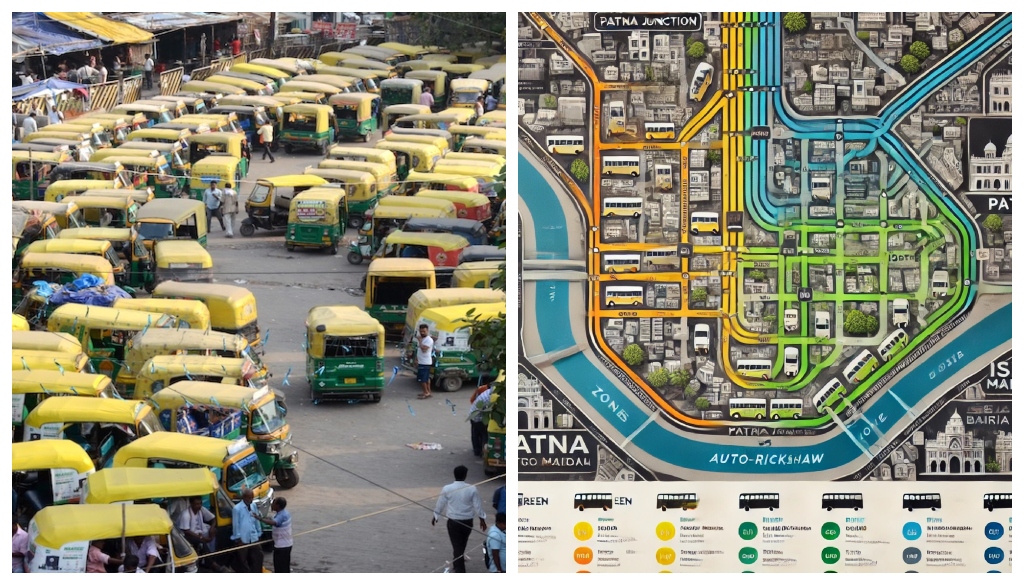
Patna: The Patna district administration has introduced a new zonal system to curb chronic traffic congestion caused by the unregulated movement of auto-rickshaws and e-rickshaws. District Magistrate Dr Thyagarajan S.M. announced that the vehicles will now operate according to a fixed route plan, with the city divided into Green, Yellow and Blue zones.

Traffic congestion around areas such as Patna Junction, Rajiv Nagar and Boring Road has long troubled commuters, with autos often cited as a major cause of gridlock. In a meeting with auto and vehicle associations, the district administration discussed the new system and secured the agreement of all organisations involved. The rules will come into force in the coming days.
Under the new plan, 26 designated routes have been mapped across the three zones. Of the 22,065 registered auto-rickshaws and e-rickshaws in Patna, only around 18,181 will be permitted to operate on these routes. An additional 10% of vehicles will be kept in reserve, while another 10% will be allocated for administrative purposes.

🚦 Patna’s New Traffic Plan: Auto & E-Rickshaw Zones Announced!
-
🟩🟨🟦 City divided into Green, Yellow & Blue zones to control auto and e-rickshaw movement.
-
🚫🚗 Unregulated autos = massive traffic jams — especially at Patna Junction, Rajiv Nagar & Boring Road.
-
🧭 26 fixed routes introduced for smoother traffic flow.
-
🛺 Out of 22,065 vehicles, only 18,181 allowed on roads at a time.
-
🔄 10% autos kept in reserve, another 10% for administrative duties.
-
👨⚖️ DM Dr Thyagarajan S.M. held talks with auto unions — all agreed to the new system.
-
🛣️ Plan aims to reduce congestion, cut wait times & make city traffic more predictable.
-
⏳ Implementation soon — commuters expected to feel relief across key choke points.
Officials say the zonal system will distribute traffic more evenly and help reduce pressure on major roads. The administration believes that regulating auto movement—rather than restricting it—will be key to easing congestion and improving travel time for residents.
Further monitoring and adjustments are expected once the system becomes operational.