
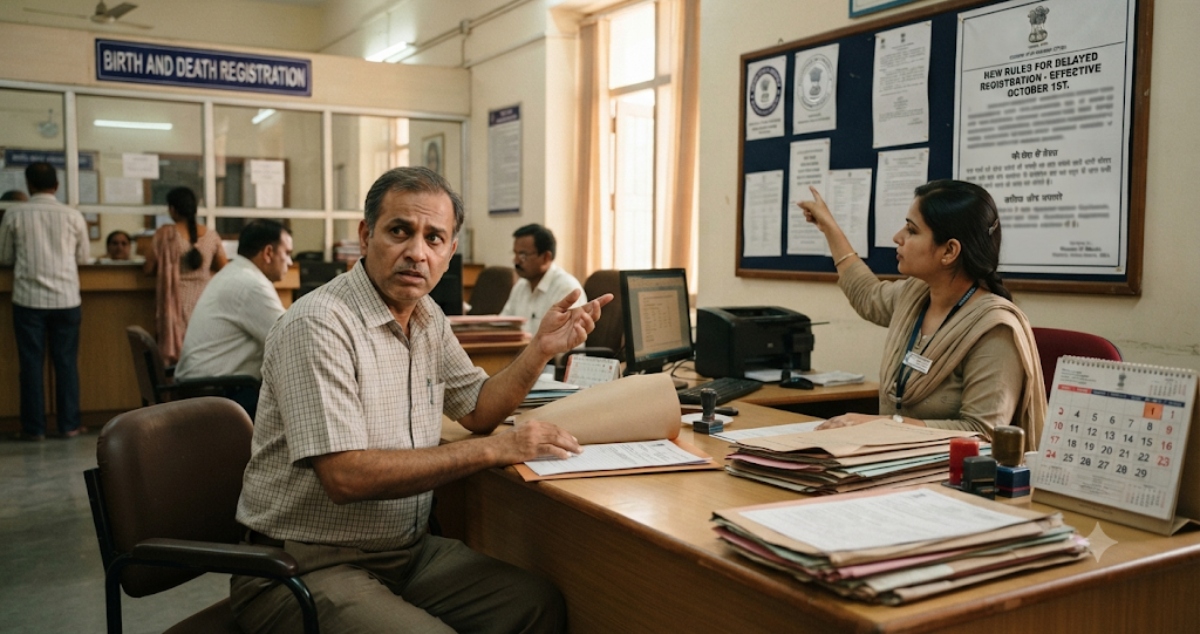
New Delhi/Patna : Getting a birth or death certificate after a long delay will become a more formal process from October 1, 2026, when the Registration of Births and Deaths (Amendment) Act, 2026 comes into force.

The amended law changes the procedure for delayed registration under the Registration of Births and Deaths Act, 1969. Depending on how long the registration has been delayed, applicants will need approval from different authorities after verification of the information.
The Central Government notified October 1, 2026, as the date on which the amended Act will come into force through a notification issued by the Office of the Registrar General of India on September 16.

Delayed Registration Between One and Two Years
If information about a birth or death is submitted after one year but within two years of the event, registration will require an order from one of the following authorities:
- District Magistrate (DM)
- Sub-Divisional Magistrate (SDM)
- Executive Magistrate authorised by the District Magistrate
The concerned authority will have to verify the correctness of the birth or death information before allowing registration. The prescribed fee will also have to be paid.
This means that cases crossing the one-year mark will no longer follow the ordinary registration route and will require an additional verification and approval process.
More Than Two Years’ Delay Will Require Judicial Magistrate’s Order
The rules become more stringent when the delay exceeds two years.
Under the amended law, a birth or death reported more than two years after the event can be registered only on an order from a Judicial Magistrate of the First Class having jurisdiction over the area where the birth or death occurred.
The magistrate will verify the correctness of the information before passing the order, and the prescribed fee will also apply.
What Was the Earlier Rule?
The 2026 amendment replaces the earlier provision governing delayed registration after one year.
Under the amended framework, the approval mechanism is now divided into two stages: more than one year up to two years, and more than two years. The first category has been placed with specified executive magistracy-level authorities, while cases delayed beyond two years require a Judicial Magistrate First Class order.
The change was passed by Parliament during the 2026 Monsoon Session. The Registration of Births and Deaths (Amendment) Bill, 2026 was passed by both Houses, with the government describing the amendment as a move towards a more streamlined verification mechanism for delayed registrations.
Why Is the Registration Process Being Tightened?
The amended law introduces a verification-based mechanism for delayed registration. The government has said the objective is to make delayed registration more stringent while creating a streamlined verification system.
Birth and death certificates are important official records. Birth registration provides formal documentation of a person’s birth details, while death registration is used in a range of administrative and legal processes, including succession and other claims.
The additional verification requirements are therefore particularly relevant in cases where registration is sought several years after the actual event.
What You Should Do Before October 1
If a birth or death in your family has not yet been registered, completing the registration process before the new provisions take effect may help avoid the additional approval requirements that will apply to delayed cases from October 1.
For cases already delayed beyond one year, applicants should be prepared for the relevant verification and approval process under the amended law.
The key rule to remember is:
| Delay in Registration | Approval Required From |
|---|---|
| Up to 1 year | Normal registration procedure, subject to applicable rules |
| More than 1 year to 2 years | DM, SDM or DM-authorised Executive Magistrate |
| More than 2 years | Judicial Magistrate First Class |
The new provisions are scheduled to take effect nationwide from October 1, 2026.