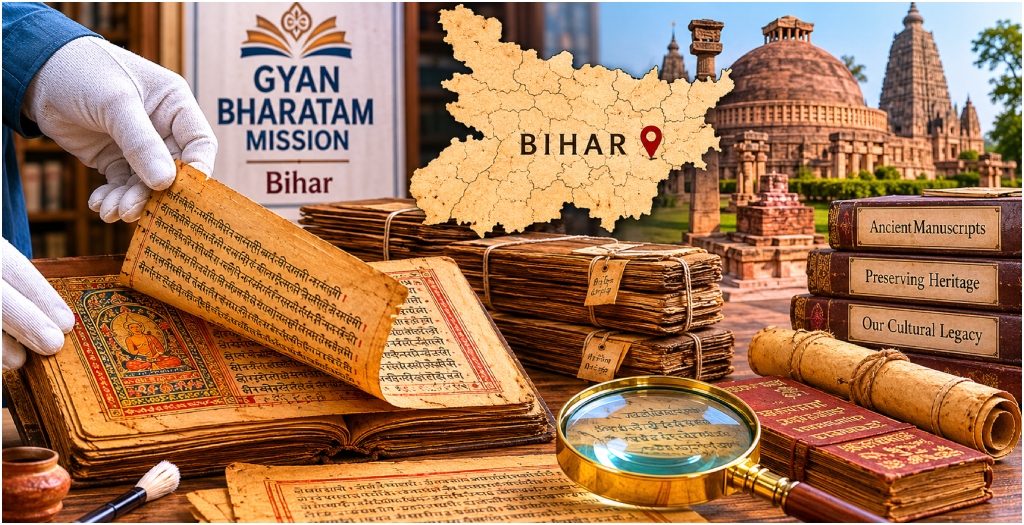
Patna: Bihar has secured the top position in the country in the ongoing manuscript survey being conducted under the Central Government’s Gyan Bharatam Mission, according to the state’s Department of Art and Culture.

Art and Culture Minister Dr. Pramod Kumar said on Tuesday that Bihar completed 1,000 survey tasks out of the 5,500 conducted nationwide, placing the state first in terms of survey execution.
He said the initiative would strengthen India’s cultural and spiritual identity while helping preserve Bihar’s historical and literary heritage.

Statewide Survey Drive
The manuscript survey began on March 16 and is scheduled to continue until June 15. Officials said the work has been carried out across all 38 districts, extending to block and panchayat levels.
To support the exercise, the Bihar government brought two historical institutions under the Department of Art and Culture after cabinet approval. These are the Kashi Prasad Jayaswal Research Institute and the Prakrit Jain Research Institute, both established in the 1950s.
A state-level committee headed by the Chief Secretary was also constituted, while district-level committees led by District Magistrates were formed in all districts.
Manuscripts Identified Across Bihar
According to the department, more than 8.5 million manuscripts have been identified nationwide so far, including over 800,000 in Bihar. The state currently ranks fifth in manuscript identification after Rajasthan, Gujarat, Uttar Pradesh and Madhya Pradesh.
Officials said several rare and historically significant manuscripts were discovered during the survey process.
These include 101 manuscripts brought to the Mahabodhi Temple by Dalai Lama in 1956, handwritten copies of the Guru Granth Sahib found in Nawada, Katihar and Saran districts, and a rare manuscript preserved at the Radha Raman Temple in Nawada.
Rare Historical Records
Among the notable discoveries is the diary of Rajkumar Shukla, recovered in Bettiah, which reportedly documents details of Mahatma Gandhi’s Champaran movement.
Officials also identified an execution order linked to freedom fighter Khudiram Bose and a manuscript attributed to Amir Khusrow in Bihar Sharif.
Other findings include Buddhist manuscripts written in Japanese at the Mayoji Temple in Rajgir, a 1,200-year-old Arabic copy of the Quran in Aurangabad, and Turfatul Fuqaha, a 450-year-old manuscript dating to the reign of Mughal emperor Jahangir.
The survey also uncovered the ninth-century text Bhagwan Adinath Puran by Acharya Jinasena at the Champanagar Digambar Jain Temple in Bhagalpur.