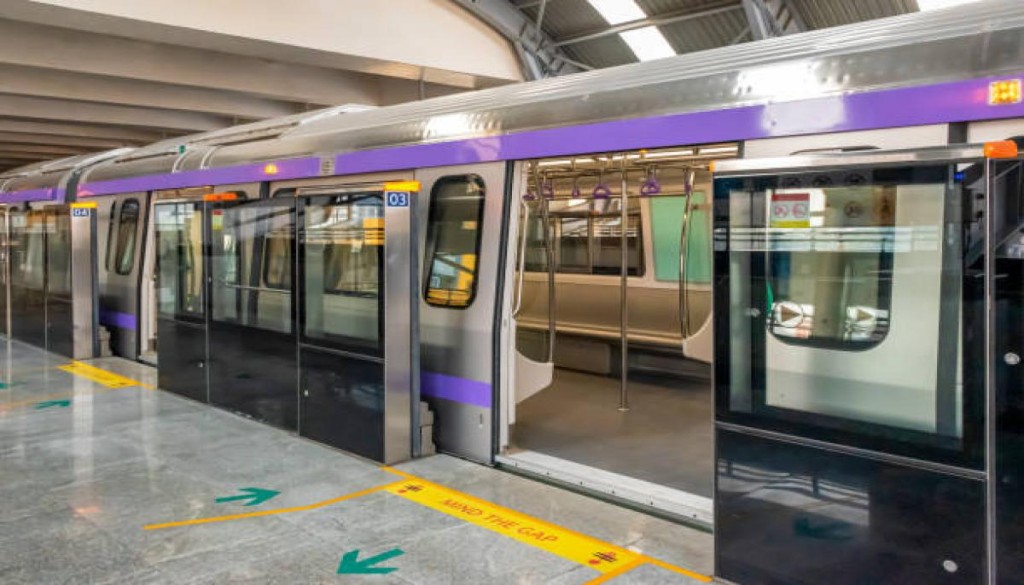
Patna: The long-awaited Patna Metro Rail Project has entered its final phase, with trial runs now underway on a key stretch of the network. The first operational segment—spanning 6.1 kilometres from the New Patliputra Bus Terminal to Bhootnath—has been earmarked for an official launch on 15 August 2025, with Prime Minister Narendra Modi expected to inaugurate the service.

A three-coach metro train, manufactured by Titagarh Rail Systems Limited in Pune, arrived in Patna on July 20 and has commenced preliminary testing at the Bairia Chak depot in Sampatchak. Initial trials, carried out with a battery-powered engine due to ongoing work on the electrified line, have reported no technical issues. Full-fledged trial runs using the power supply are expected to begin in early August, pending the completion of track and electricity connections between the depot and the terminal station.
The operational stretch forms part of Corridor-2 of the metro system, which will eventually extend 14.45 km from Patna Junction to the New ISBT. While five stations are planned along this primary segment—New Patliputra Bus Terminal, Zero Mile, Bhootnath, Khemnichak, and Malahi Pakri—the metro will initially run only up to Bhootnath, as construction on the interchange station at Khemnichak is still ongoing.

Each metro coach can carry up to 300 passengers, including 50–55 seated. With modern features such as air conditioning, CCTV surveillance, Wi-Fi, and charging points, the three-coach configuration will accommodate around 900 commuters. The service will run daily from 5am to 11pm, with fares fixed at Rs 15 for distances up to 3 km and Rs 30 for up to 6 km.
The Rs13,365.77 crore project is being developed jointly by Patna Metro Rail Corporation Limited and Delhi Metro Rail Corporation, with significant financial backing from the Japan International Cooperation Agency (JICA), which has extended a loan of Rs 5,520.93 crore. The Bihar government has also contributed Rs 115 crore for rolling stock, tracks, lifts, and escalators.
The Sampatchak depot, a central hub for operations, includes eight stabling bays for 32 three-coach trains, an automated coach washing unit, and a 2500 KVA sub-station.