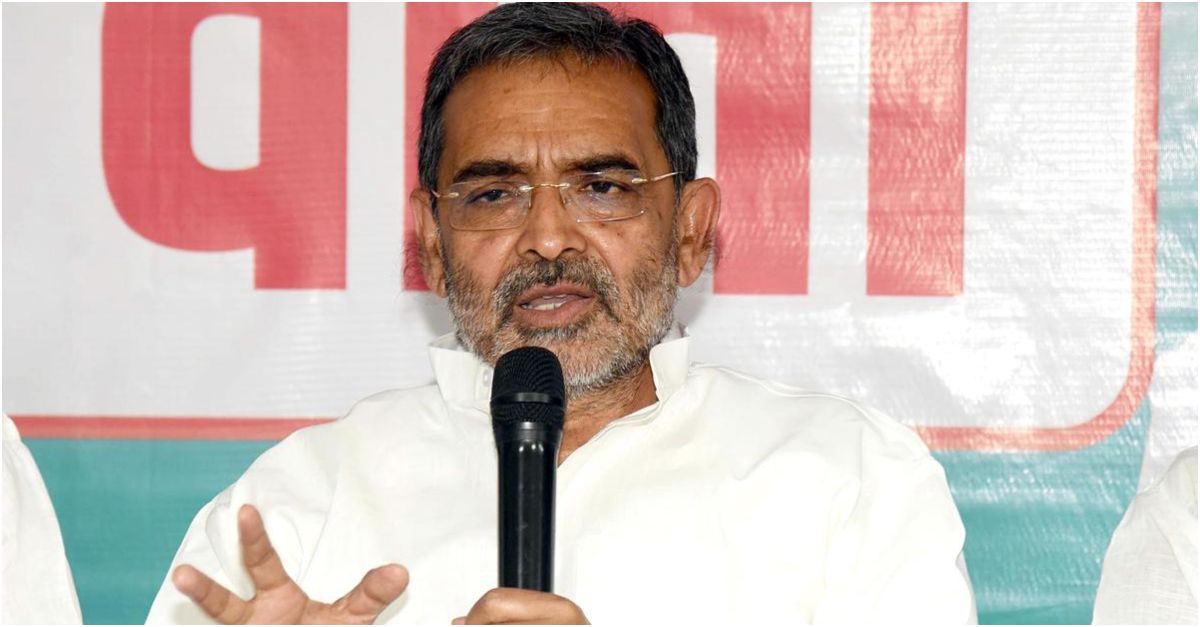
Patna: A recent statement by Rashtriya Lok Morcha (RLM) chief Upendra Kushwaha questioning Chief Minister Samrat Choudhary’s emergence as Nitish Kumar’s political successor has reignited debate over leadership succession within Bihar’s National Democratic Alliance (NDA) and highlighted the shifting power dynamics in the state’s caste-driven politics.

In an interview on June 20, Kushwaha said, “Every major leader has a responsibility to prepare the next generation of leadership, but Nitish Kumar failed in this regard.”
His remarks came just weeks after Janata Dal (United) leader Rajiv Ranjan Singh, popularly known as Lalan Singh, stated on May 16 that Nitish Kumar had personally chosen Samrat Choudhary as his successor when he decided to step down as chief minister.

“When Nitish Kumar decided to relinquish leadership, he himself determined that Samrat Choudhary would succeed him. He was not merely the Bharatiya Janata Party’s choice; he had Nitish Kumar’s blessings,” Lalan Singh had said.
Kushwaha’s comments have fuelled speculation about the future of the NDA in Bihar and the evolving relationship between the BJP and its regional allies.
Questions Over Post-Nitish Leadership
Political observers view Kushwaha’s statement as a direct challenge to the BJP’s strategy of consolidating its position in Bihar after Nitish Kumar’s exit from active leadership.
By questioning the succession plan, Kushwaha appears to be suggesting that Samrat Choudhary’s rise is primarily the result of the BJP’s organisational strength and the backing of its central leadership rather than his independent influence among the Kushwaha community.
The remarks also imply that Nitish Kumar could have considered a leader from within the JD(U) to carry forward his political legacy instead of supporting a BJP leader.
Battle for the ‘Lav-Kush’ Vote Bank
The debate over succession has also brought renewed focus to Bihar’s influential “Lav-Kush” social coalition, comprising the Kurmi and Koeri communities, which has long been considered the backbone of Nitish Kumar’s political support base.
Both Upendra Kushwaha and Samrat Choudhary belong to the Koeri community, which accounts for an estimated 4.3% of Bihar’s population.
Analysts believe Kushwaha is attempting to position himself as the principal claimant to this vote base, arguing that the Kushwaha community played a significant role in supporting Nitish Kumar’s leadership over the years.
By raising concerns over the succession issue, Kushwaha may be signalling to his supporters that he remains an active political force capable of safeguarding the community’s interests.
Concerns Over JD(U)’s Future
Kushwaha’s criticism also reflects concerns about the long-term future of the JD(U), a party widely seen as being closely identified with Nitish Kumar’s leadership rather than a strong organisational structure.
Political analysts say the endorsement of Samrat Choudhary as Nitish Kumar’s successor could strengthen perceptions that the BJP is gradually expanding its influence over the JD(U)’s traditional support base.
Some observers argue that the absence of a universally accepted second-rung leader within the JD(U) may create challenges for the party in the post-Nitish era.
Political Compulsions Behind the Succession Decision
Despite criticism from Kushwaha, analysts point out that Nitish Kumar may have had limited options within the JD(U).
Former Union minister RCP Singh had already exited the party, while Kushwaha himself had left and rejoined the JD(U) multiple times before eventually parting ways again.
Political observers note that the JD(U) lacked a widely accepted Kurmi or Kushwaha leader capable of uniting the party’s core support base, including the Lav-Kush and Extremely Backward Classes (EBC) communities.
As a result, backing Samrat Choudhary may have been more a matter of political necessity than a strategic misstep.
Changing Dynamics Within the NDA
The appointment of a BJP chief minister is expected to reshape equations within Bihar’s NDA.
Regional parties such as the Rashtriya Lok Morcha, Hindustani Awam Morcha and Lok Janshakti Party (Ram Vilas) have historically leveraged coalition politics to negotiate seats and ministerial positions.
However, political observers believe that a stronger BJP presence at both the Centre and in the state could reduce the bargaining power of smaller allies.
At the same time, the opposition Rashtriya Janata Dal faces the challenge of countering an expanding BJP outreach among Other Backward Classes (OBCs) and Extremely Backward Classes.
As Bihar moves towards the next Assembly elections, the debate over Nitish Kumar’s political legacy and the leadership of the NDA is likely to remain at the centre of the state’s political discourse.